Fighting for America's Working Families


Twitter / rightdemocrat

The Economic Populist - Speak Your Mind 2 Cents at a Time

Economic Policy Institute

Main Street

Economy In Crisis

Friday, December 08, 2006

The Great Risk Shift


Jacob Hacker, a Fellow at the New America Foundation, has written an excellent book "The Great Risk Shift." Hacker explains how the so-called "Ownership Society" has destroyed the economic stability of our working and middle class. Listed below are some disturbing facts about the consequences of trickle down economics, deregulation and the weakening of collective bargaining for American families.

http://www.greatriskshift.com/facts.html

Income Insecurity

—The size of swings of pre-tax family income from year to year has tripled since the early 1970s. This sort of income instability—how far people move up and down the income ladder from year to year — has grown faster than income inequality—the gap between people on different points on the income ladder.

—The chance that a person with average demographic characteristics will experience a 50 percent or larger drop in income over a two-year period has risen from 7 percent in the early 1970s to 17 percent in 2002.

—Personal bankruptcy has gone from a rare occurrence to a routine one. In 2005, more than 2 million Americans filed for bankruptcy—up from fewer than 300,000 in 1980.

—Income instability has risen just as quickly among the well educated as among the less well educated. As a result, college-educated workers today experience instability as great as workers without a high-school degree experienced in the 1970s.

Family Insecurity

— Parents with kids are much more likely than other adults to say they don't have enough financial resources to support themselves if they lose their jobs. All told, more than 70 percent of Americans say they could last no longer than 4 months without their current income before experiencing “significant financial hardship.”

— Married couples with kids are twice as likely to file for bankruptcy as are married couples without kids.

— Families with children are more likely than other family types to lose their homes. Since the early 1970s, the mortgage foreclosure rate has increased fivefold. Each year in the last few years, roughly one in sixty households with a mortgage have fallen into foreclosure.
Job Insecurity

— Workers are scared. In 1982, amid a severe recession that had pushed the unemployment rate up to nearly 10 percent, a poll by the private business research firm ISR found that 12 percent of workers were “frequently concerned about being laid off.” In 2005, with the unemployment rate down to 5 percent, the number of Americans worried that they would lose their jobs was 35 percent.

— Although the unemployment rate has remained low, the rate of involuntary job loss has actually been steeply rising. In the 2001 recession, the rate of involuntary job loss was essentially the same as the levels reached during the deep downturn of the early 1980s. And the costs of job loss for workers are actually above the levels of the early 1980s, particularly for more educated workers.

— A major reason for the divorce between the unemployment and job-loss figures is that many of those displaced from jobs are not counted as unemployed, because they have stopped their employment search out of discouragement. In 2005, the “shadow unemployed” consisted of as many as 5.1 million men and women, which would raise the official unemployment rate to 8.7 percent.

— Long-term unemployment—that is, unemployment lasting longer than six months—is three times as high at the peak of the business cycle as it was in the 1960s. During economic downturns, the picture is even more worrisome. Long-term unemployment has been unusually high in each of the last two recessions, and educated and professional workers are most likely to experience it.

Health Insecurity

— 46.6 million Americans lack health insurance, up from around 24 million in 1980. All of the decline is due to a drop in the scope and generosity of employer-provided health coverage. In 1980, the majority of employers at medium-to-large companies paid 100 percent of the premium for family health coverage. Today, fewer than a quarter do.

— Over a two-year period, more than 80 million adults and kids—one out of three nonelderly Americans—spend some time without the protection against ruinous health care costs that health insurance offers, and more than 50 million are uninsured for more than six months.

— One out of six working-age adults are carrying medical debt, and medical costs and crises were a factor in as many as 700,000 personal bankruptcies in 2001.

— Medicaid is now officially available to every poor child in America; yet the share of children who are uninsured has barely dropped and is still well above its level in the late 1970s. Only about 60 percent of poor children had health insurance coverage in 2002, and most of those who were uninsured lived in working families.

— With the exception of the recent prescription drug bill, Medicare coverage has remained largely unchanged since the 1960s, and still does not include a cap on catastrophic costs. As a result, seniors are actually paying a larger share of their income on medical care today than they did at the time of Medicare’s passage.

Retirement Insecurity

— In 1980, more than 80 percent of large and medium-sized corporations offered traditional “defined-benefit” pensions that provide a predetermined monthly benefit for the remainder of a worker’s life. Today, less than a third do. Instead, companies that provide plans now offer “defined-contribution” plans, such as the 401(k), in which returns are neither predictable nor assured.

— Between 1989 and 1998—a decade in which 401(k) coverage exploded and the stock market boomed—the share of families nearing retirement that found themselves likely to live on less than half of their prior income in retirement increased by a third, to more than 40 percent.

— Roughly three-quarters of 401(k) account holders in 2002 had less than the widely cited average of $47,000 in their account. The median among account-holders—which is a better measure of what’s typical—was around $13,000. And all these figures include only those who have 401(k)s. Only 53 percent of workers have access to a defined-contribution pension plan, and only 42 percent contribute to one.

— More than $100 billion dollars a year in lost income tax revenues is used to subsidize 401(k)s and other pension plans. Two-thirds of this total goes to the richest 20 percent of Americans, only 12 percent to the bottom 60 percent of Americans on the income ladder.

* IS JOHN EDWARDS GETTING TOUGH ON TRADE ?

Despite losing millions of manufacturing jobs, the stagnation of incomes among middle class Americans and a massive trade deficit, we still have many elitists who believe that "free trade" is the best thing since sliced bread. The reality that our standard of living is in decline thanks to self-destructive trade policies does not change the "free traders" insistence that "the world is flat."

Writing in his Capital Commerce column at http://www.usnews.com/, James Pethokoukis shares his fear that likely 2008 Democratic Presidential contender John Edwards is about to "raise the protectionist banner." Pethokoukis notes that Edwards has established a committee to explore running for the 2008 Democratic nomination led by former Michigan Congressman David Bonior. It seems that Bonior has consistently supported measures to secure American jobs while opposing unfair trade politicies - something that arrogant globalists tend to look at with displeasure.

"Before retiring from the House in 2002 and unsuccessfully running for governor of the Wolverine State, Bonior was one of the most protectionist members of Congress, not too surprising for a Michigan Democrat, of course. While in Congress, Bonior voted for withdrawing from the World Trade Organization, voted against presidential fast-track trade authority as well as giving China most-favored-nation trading status. His inclusion on Team Edwards leaves little doubt that the former trial lawyer will be the Sherrod Brown or Patrick Buchanan of the Dem primaries, bashing free trade and China all around the country." See complete article at http://tinyurl.com/y4qh8x

After reading the US News column, I am much more inclined to give John Edwards a second look as a 2008 Presidential possibility. As I recall, Edwards took a generally pro-fair trade position while in the U.S. Senate and on the campaign trail in the 2004 primaries but tended to downplay the issue. If Edwards is going to champion the interests of America's working class and middle class families, he might just surprise the political pundits and find a broad national base of support.

Wednesday, October 04, 2006

NLRB continues attack on collective bargaining

The AFL-CIO Weblog today has a disturbing news item http://tinyurl.com/r58zl
about the latest attempt of the National Labor Relations Board to further weaken collective bargaining rights in our nation. As you may know, the Bush Administration has long been attempting to take away overtime pay protections from millions of workers. This decision is another blow to organized labor which has been under attack since the Reagan Administration declared war on the working class in early 1981.

"The Republican-dominated National Labor Relations Board (NLRB) voted along party lines to slash long-time federal labor laws protecting workers’ freedom to form unions and opened the door for employers to classify millions of workers as supervisors. Under federal labor law, supervisors are prohibited from forming unions."

"The NLRB ruled on three cases, collectively known as “Kentucky River,” but it’s the lead case Oakwood Healthcare Inc. that creates a new definition of supervisor. Dozens of cases involving the definition of supervisor now before the NLRB will be sent back, with employers having the option to craft arguments that will meet the new definition of supervisor and limit the number of workers who can join a union."

"Although the Oakwood decision covers only nurses, the expanded definition of superviors means up to 8 million workers, including nurses, building trades workers, newspaper and television employees and others may be barred from joining unions. In Oakwood, the board agreed with the employer that charge nurses are supervisors. But the ruling also sets broad definitions for determining who is a supervisor that invites employers to classify nurses and many low-level employees with minor authority as supervisors. The decision was issued Sept. 29 but not released until today."

"The board’s new definition essentially enables employers to make a supervisor out of any worker who has the authority to assign or direct another and uses independent judgment. Amazingly, the board also ruled that a worker can be classified as a supervisor if he or she spends as little as 10 percent to 15 percent of his or her time overseeing the work of others."
"AFL-CIO President John Sweeney calls the decisions “outrageous and unjustified.”

"It’s the latest example of how the Bush-appointed NLRB is prepared to use legal maneuvering to deny as many workers as possible their basic right to have a voice on the job through their union. The NLRB should protect workers’ rights, not eliminate them. If the administration expects us to take this quietly, they’re mistaken."

"This week, working people are coming together in the streets in cities across the nation to make sure everyone knows that the Bush administration is slashing workers’ right to have a voice on the job."

"In their dissent, NLRB members Wilma Liebman and Dennis Walsh say the decision “threatens to create a new class of workers under federal labor law—workers who have neither the genuine prerogatives of management, nor the statutory rights of ordinary employees.” Liebman and Walsh wrote that most professionals and other workers could fall under the new definition of supervisor, “who by 2012 could number almost 34 million, accounting for 23.3 percent of the workforce.”

We must elect a Democratic Congress that will restore basic labor protections to America's workers.

Monday, August 21, 2006

A Blueprint for 21st Century Populism

I have just finished reading "America Beyond Capitalism: Reclaiming Our Wealth, Our Liberty and Our Democracy" by Gar Alperovitz. Don't let the title scare you. Anyone looking for a Marxist diatribe about the inherent evils of market economies will be disappointed by this book recently released in paperback by Wiley Publishers. Instead you will find a thoughtful book that presents realistic ideas about how prosperity can be expanded in our nation. "America Beyond Capitalism" is a good starting point for developing a "21st Century Populism" to effectively address growing economic inequalities and gain control over the rapidly expanding power of big business.

Alperovitz is a man of the Left on economic and social matters but he pulls ideas from across the ideological spectrum about how the American standard of living can be improved. The author pulls no punches in pointing out how tax cuts for the wealthy, deregulation, the weakening of collective bargaining protections and globalization have brought about economic stagnation for many workers, but looks for solutions rather just dwelling on the injustices resulting from these laissez faire policies.

Taking a realistic approach, Alperovitz expresses doubt that organized labor can regain its former political strength as a balance to corporate power and notes the virtual poltical impossibility of raising taxes on upper middle class suburbanites. Any successful attempt at rolling back tax cuts is likely to be directed at the upper one to five percent of the population. The dramatic growth of corporate power is illustrated by the fact that corporate taxes accounted for 35.4 percent of all federal tax receipts in 1945 and had fallen to 7.4 percent of federal receipts by 2003.

In his book, Alperovitz suggests that means of generating public revenue other than through redstribution of income need to be explored. One suggestion is to create a Public Trust which would oversee the investment of stock in the same manner as state and local public pension authorities. The proceeds from the Public Trust could flow to the federal treasury, states and even individuals. Alperovitz proposes a "Pluralistic Commonwealth" to create "new public and semi-public wealth building institutions" expanding prosperity and which "structrually tethers large scale firms at the top by lodging stock ownership in the Public Trust accountable to and open to scrutiny by the public."

Another big idea presented in the book is a system of Individual Development Accounts (IDA's). The IDA's would enable government to "directly match the savings of the poor - thus doubling their efforts and allowing low income individuals to benefit from the ownership of capital." Alperovitz describes a proposal by Yale economist John Roemer to provide every adult with "voucher-like coupons" to be used for the purchase of stock through a "new form of mutual fund."

Alperovitz makes a very insightful observation on page 73 of his book, "Neither tradional socialism nor traditional capitalism deals well with the power problems presented by large-scale enterprise. Significant economic actors in the socialist state are commonly unaccountable either to market forces or to the public, they are power systems within a power system. The modern for-profit corporation is for the most part unaccountable to the public - and contrary to traditonal theory, in most cases unaccountable to shareholders as well. As the Enron and other scandals have shown managers and top executives run the system dominating boards and annual meetings alike. Rarely are successful challenges to their power successful, even by major shareholders."

Increased tax incentives to encourage the formation of more employee owned corporations is one way that American prosperity can be expanded. Alperovitz notes that pay in employee owned firms is 12 percent higher than in non-employee owned companies. Employees of such firms earn far more value in stocks than workers with 401(k) plans which some bitterly joke that given dismal performance have become 201(k) and 101(k) plans.

Alperovitz praises neighborhood community development organizations (CDC's) for their social service projects and business development functions within economically deprived areas. CDC's are under local community control and would play a critical role in service delivery and economic development in the "Pluralistic Commonwealth." The emphasis on such social entrepreneurship has already been embraced by some American conservatives as well as even some European social democrats. In fact, some European social democracies long used voluntary organizations for service delivery rather than expanding government. Anthony Giddens, writing in "The Third Way: The Renewal of Social Democracy" (Polity 1998) indicated that in Germany, Holland, Belgium and Austria about half the social services are provided by private groups. Certain functions like operating day care centers are almost universally left in the hands of private non-profit organizations.

Reinventing government would also be a focus of the "Pluralistic Commonwealth." Alpervoitz observes the "threat of privatization" can sometimes to improve government performance. The author tells of the experience of former Republican Indianapolis Mayor Stephen Goldsmith who won election on a platform of vigorous privatization of public services. After winning election, Alperovitz writes: "Goldstein became convinced that 'competition' - not privatization per se provided the key to improving city services and reducing costs. Public employees were allowed to bid on city contracts, and to redesign their offices and operations in the process. Public employees won the majority of the contracts put out to bid, with estimated savings of $135 million in the program's first three years." Alpervovitz notes that city owned power companies in several major cities provide electric service at a cost of 11 percent less than investor-owned power companies. A municipally owned utility in Glasgow,KY offers high speed internet access for less than private competitors and Cable TV service with 80 digital channels for $15.95 per month.

Alperovitz describes the coming insolvency of our Social Security system but notes that a collapse is not inevitable. The author presents several possible solutions to the crisis which include raising the earnings limit, a 1 percent net worth tax and allocating a portion of Social Security contributions to an equity-invested fund that would operate in a similar fashion to the Federal Thrift Savings Plan.

Health care reform is likely to become viable again. While insurance companies were successful in blocking the last serious attempt to expand access to health care for all Americans, public opinion supports such a change and many corporations now favor some form of national health insurance.

Displaying something of a libertarian streak, Alperovitz suggests the potential for greater automony at the state level and the possible transfer of many powers of the federal government to the states or some form of regional government structures. Some of this appears rather unrealistic at the present time but may come into existence in the future especially given the growing cultural and ethnic divisions in our nation. The author points out that large states like California, Texas and California are increasingly diverse and have much larger populations and economies than many nations.

At times, "America Beyond Capitalism" seems like a confused jumble of sometimes conflicting ideas about how properity and personal liberty can be expanded in America, but Alperovitz at least does present a number of creative solutions for the growing income inequality in our nation.

I disagree with Alperovitz's positions on some matters such as the likely impact of illegal immigration in the U.S. The right kind of immigration could help to solve the Social Security shortfall, however, massive numbers of unskilled newcomers are likley to make our economic and social problems worse. Like many progressives, Alperovitz is convinced that a large influx of poor and low skilled individuals from south of the border will create a political environment more inclined toward activist government and challenging corporate power. This seems unlikely as a larger class of impoverished Americans will make social programs more expensive and therefore less likely to be supported by the surburban upper middle class fearful of tax increases and certainly the influential wealthy. Furthermore, many of these new immigrants may not be inclined to vote or end up voting against their economic interests just as significant numbers of working class and native born Americans do.

"America Beyond Capitalism" is well worth reading. The book presents ideas that will be of interest to a wide range of Democrats. There are some excellent ideas presented that populists, progressive, centrist-New Democrat and and libertarian Democrats can agree on.

http://tinyurl.com/o3ab3

Saturday, August 12, 2006

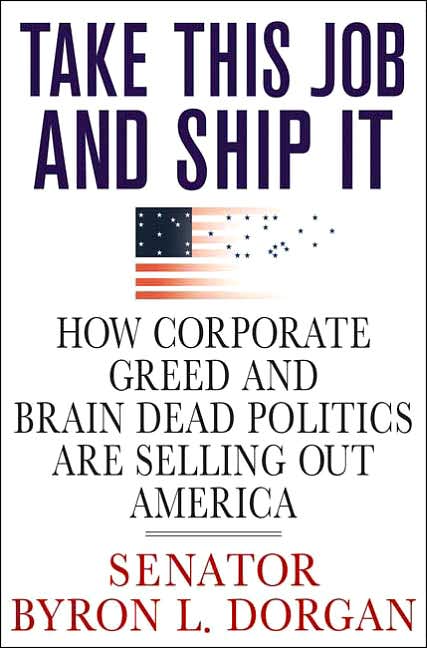
Take This Job and Ship It


Here's a review of Senator Byron Dorgan's new book titled "Take This Job and Ship It: How Corporate Greed and Brain Dead Politics are Selling Out America" from St. Martin's Press.

This is an important book that deserves to become a best seller. As big companies move their jobs to China, sell their products in America, and run their profits through the Cayman Islands to avoid taxes, they undermine American workers and threaten our future. For some commentators, the world may seem to be “flat,” but Senator Byron L. Dorgan knows better.

With both barrels blazing, the senator from North Dakota contends in this forceful and provocative book that while exporting jobs may be good for the giant corporations, it is a disaster for America as a whole. Trade can’t be “free” when our small businesses and working people are expected to compete with exploited workers and slave labor in third-world nations that care little about the conditions in their factories and not at all about the pollution they generate.

Our trade deficit now increases by $2 billion a day, but pharmaceutical companies have such influence in Washington that Medicare, by current law, is not allowed to negotiate lower drug prices. We import oil on an ever-increasing scale, putting ourselves into debt with the Saudis, the Kuwaitis, and other Middle Eastern nations; with their windfall profits, they continue to buy American assets.

China’s booming economy and abundance of cheap labor is threatening our economic survival as America’s manufacturing base is dismantled.We have mortgaged our fortunes, our principles, and our way of life.With biting wit and an unerring moral compass, Dorgan weaves colorful stories about the dancing grapes from Fruit of the Loom underwear, Fig Newton’s escape to Mexico, the disappearance of the flag decal from Huffy bicycles, and how a trade agreement sent exotic dancers to Canada. He exposes the absurdity of our global-trade policies, and isn’t afraid to name names.

Dorgan pulls no punches and, most important, he offers a refreshing, bold strategy for putting our country back on track. America can once again be a booming exporter as well as a good trading partner with the whole world, but to mindlessly cheer on the loss of more than 3 million jobs (and that’s only the beginning) is just plain folly.

In the long run, the United States cannot help the rest of the world by impoverishing its own people and bankrupting its own economy. With a little courage and some original thinking, the negative trade balance can be slowed, even stopped and reversed.

Senator Dorgan’s is a message that must be heard – before it is too late.

* THE REAL CLASS WARFARE

Apologists for corporate greed often accuse economic populists of engaging "class warfare." Well, the real class warfare is being waged by overpaid CEO's who give receive additional perks while insisting that employee benfits and pensions must be reduced or eliminated.

Froma Harrop, one of my favorite syndicated columnists, called attention to this hypocrisy in Wednesday's Seattle Times http://tinyurl.com/o5xhl

"It's not news that American executives have put ordinary workers' benefits on a diet while they go for a fourth helping. What makes this redistribution of corporate wealth special is its brazen and unblushing quality. We are not talking here about some stock option deal where the top guys are rewarded for increasing shareholder value. In this case, the money gushing into the executive suite is simply being siphoned through holes drilled in workers' paychecks."

An example, courtesy of The Wall Street Journal:"General Motors has long complained that its "legacy costs" have made the automaker dangerously uncompetitive. By "legacy costs" it means the health benefits and pensions that it promised its workers and retirees. In an effort to ease those "burdens," GM recently announced it would end pensions for 42,000 of its salaried employees."

"But guess what The Journal discovered? It found that the fund for those middle-class pensions was actually bulging with $9 billion more than was needed to honor them. The real problem, it turns out, was GM's executive pensions, which management had been supersizing even as it demanded cuts from the lower-downs. GM's executive-pension obligations, we learn, are $1.4 billion."

"General Motors is not the only company to have built up extravagant pension deals for the privileged few. Executive-pension liabilities have hit $3.5 billion at General Electric, $1.8 billion at AT&T, and $1.3 billion at ExxonMobil and at IBM. "Sometimes a company's obligation for a single executive's pension approaches $100 million," The Journal reports.

"Cleary, the workers whose pension plans have been frozen aren't the only ones losing out. These unfunded executive pensions suck off earnings that are supposed to be going to the stockholders."

Corporate executive officer benefits are clearly out of control. Companies should not be allowed to escape their pension obligations and even file for bankruptcy under Chapter 11 while continuing to provide outlandish compensation packages to CEO's.

Saturday, July 08, 2006

Dick Cheney bets against U.S. economy

Counterpunch http://counterpunch.com posted an excellent column on July 5 by Mike Whitney on how Dick Cheney is betting against the American economy. The Cheney investment strategy certainly helps to explain why how our leaders are so indifferent to the prospects of a U.S. financial collapse.

"Wouldn't you like to know where Dick Cheney puts his money? Then you'd know whether his "deficits don't matter" claim is just baloney or not."

"Well, as it turns out, Kiplinger Magazine ran an article based on Cheney's financial disclosure statement and, sure enough, found out that the VP is lying to the American people for the umpteenth time. Deficits do matter and Cheney has invested his money accordingly."

"The article is called "Cheney's betting on bad news" and provides an account of where Cheney has socked away more than $25 million. While the figures may be estimates, the investments are not. According to Tom Blackburn of the Palm Beach Post, Cheney has invested heavily in "a fund that specializes in short-term municipal bonds, a tax-exempt money market fund and an inflation protected securities fund. The first two hold up if interest rates rise with inflation. The third is protected against inflation."

"Cheney has dumped another (estimated) $10 to $25 million in a European bond fund which tells us that he is counting on a steadily weakening dollar. So, while working class Americans are loosing ground to inflation and rising energy costs, Darth Cheney will be enhancing his wealth in "Old Europe". As Blackburn sagely notes, 'Not all bad news' is bad for everybody."

"This should put to rest once and for all the foolish notion that the 'Bush Economic Plan' is anything more than a scam aimed at looting the public till. The whole deal is intended to shift the nation's wealth from one class to another. It's also clear that Bush-Cheney couldn't have carried this off without the tacit approval of the thieves at the Federal Reserve who engineered the low-interest rate boondoggle to put the American people to sleep while they picked their pockets."

"Reasonable people can dispute that Bush is 'intentionally' skewering the dollar with his lavish tax cuts, but how does that explain Cheney's portfolio?"

"It doesn't. And, one thing we can say with metaphysical certainty is that the miserly Cheney would never plunk his money into an investment that wasn't a sure thing. If Cheney is counting on the dollar tanking and interest rates going up, then, by Gawd, that's what'll happen."
"The Bush-Cheney team has racked up another $3 trillion in debt in just 6 years. The US national debt now stands at $8.4 trillion dollars while the trade deficit has ballooned to $800 billion nearly 7% of GDP."

"This is lunacy. No country, however powerful, can maintain these staggering numbers. The country is in hock up to its neck and has to borrow $2.5 billion per day just to stay above water. Presently, the Fed is expanding the money supply and buying back its own treasuries to hide the hemorrhaging from the public. Its utter madness."

"Last month the trade deficit climbed to $70 billion. More importantly, foreign central banks only purchased a meager $47 billion in treasuries to shore up our ravenous appetite for cheap junk from China."

"Do the math! They're not investing in America anymore. They are decreasing their stockpiles of dollars. We're sinking fast and Cheney and his pals are manning the lifeboats while the public is diverted with gay marriage amendments and 'American Celebrity'."

"The American manufacturing sector has been hollowed out by cutthroat corporations who've abandoned their country to make a fast-buck in China or Mexico. The $3 trillion housing (equity) bubble is quickly loosing air while the anemic dollar continues to sag. All the signs indicate that the economy is slowing at the same time that energy prices continue to rise."
"This is the onset of stagflation; the dreaded combo of a slowing economy and inflation."

"Did Americans really think they'd be spared the same type of economic colonization that has been applied throughout the developing world under the rubric of 'neoliberalism'?"

"Well, think again. The American economy is barrel-rolling towards earth and there are only enough parashutes for Cheney and his gang."

Sunday, June 25, 2006

Time to limit CEO pay

Edward Rubin, Dean of the Vanderbilt University Law School,. wrote an excellent op-ed column which appeared in Wednesday's Atlanta Journal-Consitution. Rubin makes an excellent case for limits on executive compensation and redistributive tax policies. http://tinyurl.com/l63jw

"Income disparities are an increasingly serious problem in this country. At present, the top fifth of the population receives more than 50 percent of the nation's annual income, while the bottom fifth receives around 3.5 percent. In addition, the percent of total national income has declined over the past quarter-century for the bottom 80 percent — while the share of the top 20 percent has steadily increased. As a result, we are approaching the income disparity levels of a Third World country."

"The theme that should be sounded is that the present distribution of income is simply unfair. Most of the adults in those lower four-fifths, even the ones in the lowest, work for a living, and most work as hard as the people in the top fifth. Our system is tilted against them."

"The reason for our income disparity is not that the people in the top fifth deserve so much more money, but that we have a regressive tax system, excessive tax loopholes for the wealthy, unmonitored corporate compensation and a defective public educational system that limits social mobility and the ability of people who can't afford private school to develop their talents. The image of the lazy, unmotivated poor is largely a myth, and certainly doesn't apply to four-fifths of our population."

"So how can we deal with this in a progressive manner? To begin, raising the minimum wage is probably a good approach, but lowering the maximum wage may be an even better one."

"Executive compensation has reached stratospheric levels in the United States, largely because of stock options and other incentive-related payments. This sounded like a wonderful idea at the time it was first conceived — pay the top executives better if the firm makes higher profits — but it has spiraled out of control. The problem is that the corporate board members who approve these payments are spending the firm's money, not their own; they don't benefit from the firm's profit levels or suffer if the firm squanders its resources on excessive executive salaries."

"Unfortunately, the only way to limit executive compensation is through national regulation, and there does not seem to be much taste for solutions of this sort."

"The other way to redistribute income is through the tax system. One would imagine that a redistributive tax system would garner widespread popular support. But it is a somewhat weird feature of the American mentality that so many people in this country think they have a chance of becoming wealthy, and often identify more closely with the interests of an increasingly remote elite than with their own interests. This is amplified by the continuing reverberations of frontier individualism, the belief that people deserve to keep "their" money, and should not have it taxed away for public purposes."

"For both these problems — excessive corporate compensation and a regressive tax system — I think we need a new political discourse. People need to understand that everyone's money comes from the economic system to which we all contribute."

We need to return to progressive taxation and create disincentives for corporations to provide such outlandish salaries and benefit packages for CEO's

* CAN GOVERNMENT DO ANYTHING RIGHT ?

I disagree with those who maintain that government is inherently wasteful and ineffective. The public sector certainly can be both just as the private sector often provides poor quality workmanship and customer service.

Democrats are often better at governing than Republicans as they have a more positive attitude toward government activism. Government agencies can become more innovative and customer friendly with the right leadership and values. There is no reason for example that government offices cannot be open more flexible hours (like evenings and weekends) to offer better service to the public. Like big corporations, public bureaucracies can encourage a drone-like attitude among employees or promote an organizational culture of innovation.

Government can be as efficient in delivering services as the private sector. I think our military has done a great job considering the demands and limited resources that they must work with. Our police and firefighters show courage every day to protect and save lives. I can't imagine rent a cops and private firefighters showing the same dedication. The postal service ? Well, that could use a lot of improvement but much of the decline in service quality can be traced to the replacement of career civil service workers with the temp-like "casuals" who don't always have the same dedication to their duties.

Jacksonville,FL has a city-owned electric authority (JEA) which does an excellent job of providing power to the Duval County area. The rates are actually lower than profit-making private power companies such as Florida Power & Light and Tampa Electric.

I am not suggesting at all that every enterprise should be run by the government but rather that government can do and actuallty does some things better or as well as the private sector. And there are areas like education that have traditionally been a public-private partnership like education. I'm all in favor of public education and some of our public schools excel at educating and training their students. Of course, some students fare better in a private or church-related school environment. Private and parochial schools have always educated a significant minority of our children. I see no conflict between experimenting with voucher programs to assist low to moderate income parents who wish to send their kids to a private school with supporting and further improving the public school system.

Likewise, I don't think it is always a bad idea for government to outsource certain functions to the private sector if a business can be made that they do the job more efficiently without compromising the quality of service. A lot of services in our society can be potentially be a private-public partnership. There is nothing wrong with workers in the public sector competing with those in the private sector as long as both are given the necessary tools to do their job.

The answer isn't always creating or making a government agency bigger or mindlessly just declaring government bad and contracting all functions out to the private sector. In privatization mad Florida under the leadership of Jeb Bush, we've seen examples of how private companies often performed less efficiently than government agencies. Governing sometimes requires a little common sense and removing the ideological blinders - right or left.

Sunday, June 11, 2006

Republicans reward big business - not values voters

I happen to oppose gay marriage (and support a constitutional amendment banning it) but agree with this UK Guardian columnist via the Tapei Times. The Republicans want to use social conservatives for votes while big business gets whatever they want. Progressives need to recognize that big business is the real enemy - not the socially conservative values voters. Democrats must realize as JonathanFreedland that getting into a conflict with values voters is unwise. Our party needs to stress economic issues and allow for a difference of opinion on social matters such as gay marriage and abortion. http://tinyurl.com/q4glr

Bush's play to the Christian right is a red herring
The US President is once again pandering to so-called `value voters'over gay rights, but Democrats and other progressives should not bedistracted from the real enemy
By Jonathan FreedlandTHE GUARDIAN , LONDONSaturday, Jun 10, 2006,Page 9

"Well, it gave US President George W. Bush the presidency oncebefore, so why not use it again? Our old friend gay marriage is back, evoked anew by the man in the White House to scare "values voters," most of them Christian conservatives, into voting Republican one more time."

"It did the business in 2004, when Bush's efforts to turn the electioninto a referendum on same-sex unions may well have tipped the pivotalstate of Ohio, chiefly by persuading social conservatives to get out and vote. So it's no surprise to see a tired Bush, facing second-termpoll numbers in the Nixon depths, reaching for the same stick now."

"Bush wants to amend the Constitution so that that precious charter ofrights and liberties will include a new sentence defining marriage exclusively as an arrangement between a man and a woman. Such an exclusion clause would demean the document, like graffitiscrawled across a sacred text. The Constitution has been alteredbefore -- but usually to expand rights, not to restrict them."

"The president and his allies wrap this up in the usual preachy language, of course -- stand by for the radio pastors intoning that "It was Adam and Eve, not Adam and Steve" -- but there is nothing holy about this mission. It's brazen politics, an obvious lob of red meat to the hungry of the Christian right. If they gobble it up they will show just how easily they are bought. Abroad it will confirm an impression many have had of the US for awhile: that the country is on its way to becoming a theocracy, with the evangelical right organizing methodically, and over decades, to take over the commanding heights of the country. Europeans and others shudder at the polls which show that 40 percent of people in the US would support a ban on the teaching of evolution in schools, while two-thirds believe creationism should be taught alongside Darwin in the schools."

"With a leader who shares those sentiments ruling over White House, it's been easy to see this as the faith-based presidency. In this view, the salient feature of the Bush era has been its religiously rooted, Manichean vision of the world, seeing the US as locked in a holy struggle of good against evil."

"Such a view is certainly appealing: it's simple and it would explain a lot. But it would be woefully incomplete. For there has been another force at work during the Bush years, one that can claim amuch larger, if less publicized, role in shaping the policy of thepresent era. Take this very week in Washington. While the talk shows and blogs are humming with gay marriage, the Senate will debate the permanent abolition of the inheritance tax. Republicans are already rebranding this the death tax, as if the wicked government insists on squeezing even the corpse on the undertaker's slab. But the truth is that only three estates in every thousand are eligible for tax under the current law: everyone else pays nothing. But those three matter, because they're the estates worth more than US $4 million -- and it's those families Bush wants to help. No change there."

"In his very first months as president, Bush passed a tax cut that overwhelmingly benefited the wealthiest 1 percent ofAmericans, a redistribution of money from poor to rich that will leave the most affluent a staggering US $477 billion better off over a10-year period. That, rather than any religious crusade, has been the true hallmarkof the Bush era. In every sphere it has been the wealthy, andparticularly big business, who have been the true beneficiaries --and often architects -- of Bush policy."

"Energy is a case in point. Just 10 days after his arrival in theWhite House, Vice President Dick Cheney, fresh from running the oilservices and construction company Halliburton, convened asecret "energy task force," an unelected group that set about makingthe oil and gas companies' dreams come true. Whether they wanted more drilling, mining or deregulation, they got it."

" One telling documentwas a wish-list memo from Enron: a later congressional analysisshowed that 17 policies sought by Enron, or which directly benefitedthe company, were included in the task force's final report. Again,no big surprise: Enron had been a generous giver to the Bush-Cheneycampaign in 2000.Cheney managed to keep the task force away from democratic scrutiny,but occasionally the curtain was tugged back."

"A rare and choice example is the case of Philip Cooney, who served until last year aschief of staff for the White House council on environmental quality.It turned out that Cooney had been quietly editing reports bygovernment scientists on global warming, wielding his pencil to castdoubt on climate change. One sentence asserting that the world "is"getting hotter was rewritten to say that it "may be."

"Yet Cooney had no scientific training. His sole qualification for thejob was that he had previously worked for the American PetroleumInstitute, the chief lobby group of the oil industry. He was forcedout of the White House, but that was no problem. He got a new job --as a spokesman for ExxonMobil."

"There are countless other examples, from the gutting of the Clean AirAct to Bush's attempt to dismantle the US pensions system known as social security -- a Roosevelt-era institution valued by Americans on middle and low incomes, but irrelevant to the rich and powerful."

"The symbol of this closeness between the White House and the boardroom remains Halliburton itself, which was awarded three massively lucrative reconstruction contracts in Iraq without even suffering the inconvenience of having to bid for them. We're told that Cheney played no part in allocating those contracts. But he wouldn't have to, would he?Those who want to take on the Bush administration should keep all this in the forefront of their mind."

"The Christian right may be thejuicier, more telegenic target, but they are not the sole, or even central, driving force of US policy.Where does that leave Democrats? It suggests they must keep theirsights on the real enemy. It does not pay to get into a fightwith "values voters." More important is to make a moral case against poverty, environmental despoliation and a greed culture."

Populism is a major American political philosophy

A study released in April by the Pew Research Center shows that populism is still a major political philosophy among American voters.It is a fascinating poll. Go to the link and check it out as there is some really interesting survey data.
http://pewresearch.org/obdeck/?ObDeckID=17

Here's an excerpt from the Pew Research Center report:

"In the political caricature of recent years, America is a nation divided: red vs. blue, conservative vs. liberal. "Liberals" tend to favor an active role for government in regulating the economy, but oppose government attempts to regulate morality or private life in the social sphere. "Conservatives" take just the opposite approach, preferring a smaller role for government in the economy but a bigger role for it in promoting morality. Not surprisingly, liberals and conservatives are political opponents on most issues."

"But while there is little question that U.S. politics have become more polarized in recent years, the red-blue political shorthand is far from adequate to describe the full spectrum of Americans' political views. Judging by their opinions on a number of issues, many Americans simply do not fit well within either the conservative or the liberal ideological camps, instead falling into one of the two other important U.S. political traditions - libertarian and populist -or defying attempts to pigeon-hole them."

"Americans espousing a "libertarian" ideology oppose government regulation in both the economic and the social spheres."

"Populists,"by contrast, favor an active role for government in both the economic and the social spheres. Still more Americans are distinctively non-ideological in their political outlook, and so don't fit neatly intoany of the four ideological camps."

Many of us don't fall into the standard left-right ideologies . There is no logical reason why one cannot - for example -opposing abortion and gun control while favoring national health insurance and public funding of political campaigns. Populists do have a consistent political philosophy - that government uphold the rights of workers and consumers as well as traditional moral values.

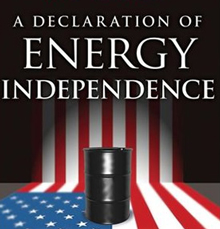
Our fuel can be made in the U.S.A.

Senator Ben Nelson (D-NE) is right that our fuels need to have a "Made in America"sticker. We must move quickly to encourage the use of ethanol. It is a cleanand renewable fuel and increased use will be great for our nation's farmers as well as reducing the trade deficit.

One interesting thing that I learned recently is that ethanol can be produced not only from corn, but also from sugarcane. According to the New York Times (04/10/06), Brazil which has widespread use of ethanol gets eight times the yield from sugar cane based product that is made in their country than from corn based ethanol. We grow sugar cane already in Florida, Louisiana, Texas and Hawaii and sugar beets are grown inMinnesota and Montana. Our government needs to take the lead in promoting the development of sugar cane based ethanol in the United States. All vehicles with engines built after 1970 can use the 10% ethanol, but we need to get more new vehicles on the road that have the capability of using the E-85 ethanol which consists of 85% ethanol and 15% gasoline.

The "fair tax" fraud

Let's call the "fair tax" proposal( being pushed by Congressman John Linder (R-GA) and radio Neil Boortz) what is really is - a national sales tax. Unless we abolish our military and entire social safety net, thenational sales high will have to be quite high in order to make upfor the lost income tax revenues. If enacted, the "fair tax" would increase the price of houses, vehicles, appliances and other items by at least 25%. Even if the proposed national sales tax exempts basics like food and medicine - the working class and the middle class are likely to pay a higher percentage of their income in taxes that the wealthy. If the "fair tax" becomes a reality - the working class will suffer as the rich investor class reaps the benefits. We will see even more of a gap between poor wage earners and a wealthy few.The notion that we could abolish the I.R.S. if a national sales tax is enacted is simply unrealistic. Most states depend primarily on voluntary compliance from businesses. A lot of sleazy businesses are already shorting the state governments on sales tax receipts or perhaps not paying any sales tax. Many companies do business in multiple states. Even with a national sales tax, we will need a federal tax collection of some form.

Ending progressive taxation is likely to have a devastating impact on the non-profit sector. Wealthy people are not going to give as much money to charities if they have no way of getting a tax break. A lot of great things have been accomplished by rich individuals trying to minimize their tax liabilities. If the incentive to give make charitable contributions is taken away - social service agencies, arts and cultural organizations, religious societies and churches are going to see a large drop in donations. Of course, this will have a negative effect on our social fabric as religious and charitable insitutions are weakened.

Evidence of growing income inequality

I don't always agree with The Nation magazine http://www.thenation.com/
on social and foreign policy issues, but find that they are right on target when it comes to economic matters. The article below by Leon Friedman about the rising income inequality in our society shows how the rich are getting richer as the poor get poorer while the middle class just slowly fades away.

"Every three years since 1989, the Federal Reserve Board has prepared a Survey ofConsumer Finances (SCF), which carefully measures the net worth of all households in the nation--that is, the total assets owned by all Americans. Thesurvey, the most complete and thorough analysis of individual wealth, summarizesthe financial resources of different groups of the population, such as bank accounts, stocks, bonds, business assets and real estate. The most recent report, issued early in April 2006, details the massive inequality of wealth in the United States between a small number of households at the top of the income scale and those in the bottom half. This report and other similar studies emphasize that this wealth inequality is growing and is becoming a permanent part of our society."

"The latest report examined the distribution of wealth in 2004 and makes detailed comparisons showing the change in wealth among various population groups. It notes the following:"The total net worth of all Americans in 1989 was $25 trillion (in 2004 dollars).Of that amount, the top 1 percent owned 30 percent, or $7.775 trillion. The bottom half owned 3 percent of the total, or $763 billion."

"Fifteen years later, in 2004, the total wealth of all Americans had doubled to$50.25 trillion. The top 1 percent of the population now owns 33.4 percent ofthe total, or $16.774 trillion. Their percentage share of the total has increased by more than 3 percent in fifteen years. At the same time, the total wealth owned by the bottom 50 percent increased to $1.278 trillion, but its percentage of total wealth declined from 3 percent to 2.5 percent in the sametime period."

"Thus the wealth of the top 1 percent was ten times the wealth of the bottom 50 percent in 1989. Fifteen years later, the wealth of the top 1 percent was thirteen times the wealth of the bottom 50 percent."

"Examining the type of wealth owned by each group, the SCF reports that the top 5 percent of the population owns 85 percent of closely held business assets in the country, 79 percent of the publicly traded stocks and 70 percent of mutualfunds.""At the bottom of the scale, the story is far different. While many reports have claimed that about 50 percent of households own some stocks or shares in mutual funds (either directly or through IRAs or company pension plans), the actualamount held is quite small. According to the SCF, the bottom 50 percent own less than 1 percent of business assets, stocks and mutual funds--so much forPresident Bush's claim that we need to reduce taxes on dividends and capital gains because we are an "ownership society" with so many Americans owning shares. The principal asset of the bottom 50 percent is the value of their homes, usually heavily mortgaged."

"The reason for this change is not difficult to discern. Beginning with the reduction of income tax rates in the Reagan Administration (from a high of 70 percent for the richest taxpayers in 1980 to 35 percent now), Congress has steadily reduced tax rates. It has reduced and is seeking to eliminate the estate tax altogether. In 2003 Congress lowered the tax on dividends to 15percent, rather than treat it as ordinary income subject to the highest tax rate of 35 percent. It also reduced taxes on capital gains from 20 percent to 15 percent. Necessarily, these changes greatly benefited the households at the top of the wealth ladder."

"Where can this largesse for the wealthy come from? If the government has a program of tax reductions for the wealthiest, necessarily this leads to budget shortfalls and then a decrease in welfare payments to the people at the bottom.Where else could this money come from? Certainly not from military expenditures.Congress passed a budget resolution last year that cut $10 billion in Medicaid programs, $3 billion from food stamps and $7 billion from student loan programs.The House has passed new resolutions this year calling for even greater reductions in these programs."

"The growing inequality between the very rich and the bottom half affects every aspect of American life--healthcare, education, occupational opportunities. But those in the bottom half find it harder and harder to move out of their sorry condition, as those on the top fight to protect their position and have the assistance of the politicians who pass law after law favoring their interests."

This article can be found on the web at:http://www.thenation.com/doc/20060529/friedman