Thursday, November 25, 2010
Movie "Unstoppable" salutes working class heroes
"Unstoppable" hit theaters two weeks ago and while it was no secret that stars like Denzel Washington, Chris Pine, and Rosario Dawson would save the day, the film treats audiences to an unpredictable plot twist. Spoiler alert… the heroes are actually blue-collar union members.
The movie is a Hollywood adaptation of a real crisis—a runaway CSX train loaded with hazardous materials that brought northwest Ohio to the brink of disaster in 2001—and viewers will no doubt be entertained by the dramatization and amped up action scenes. But the film also depicts a number of patently real challenges that working Americans face everyday. Company executives put profits over public safety, choosing not to derail the runaway train due to cost and the potential impact on stock prices. As a result, it's up to the workers themselves, members of the United Transportation Union (UTU), to get the runaway train under control. And that's just what they do.
The hit blockbuster immortalizes a true American story. Every day, all over the country, hardworking women and men roll up their sleeves, go to work, and do what it takes to keep our communities safe and our country moving forward. And yet America's workers are under constant assault from corporate interests that value their bottom line above all else.
The newly-elected friends of Big Business are gearing up to cut unemployment benefits, slash pay for public workers, privatize Social Security, and roll back workers' right to form a union free from intimidation. In the context of that political reality, "Unstoppable" serves as a timely reminder of the critical role workers and their unions play—whether that's serving as a check against corporate greed, ensuring public safety for all Americans, or giving ordinary nine-to-fivers a voice in the workplace.
http:/www.unstoppablethemovie.com


Sunday, November 21, 2010
Washington Monthly: Don't Repeat Failure and Expect Success
Steve Benen writes at Washington Monthly:
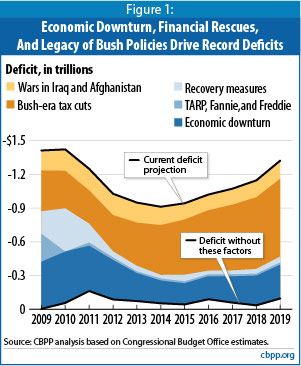
When Republican policymakers slashed taxes early in George W. Bush's first term, they had high hopes about what the policy would achieve. Americans were told, for example, that these tax cuts would create millions of jobs, keep a balanced budget, and generate robust economic growth.
As this tax policy gets ready to expire next month, it's worth noting that the Republican plan failed rather spectacularly. On job creation, Bush's record was the worst since the Great Depression. On balancing the budget, Bush racked up the biggest deficits ever, and added $5 trillion to the debt, en route to being labeled "the most fiscally irresponsible president in the history of the republic" by his comptroller general.
But what about economic growth? Did the Republican tax policy generate the robust economy Bush promised? David Leonhardt, responding to a Fox News item, sets the record straight.
Those tax cuts passed in 2001 amid big promises about what they would do for the economy. What followed? The decade with the slowest average annual growth since World War II. Amazingly, that statement is true even if you forget about the Great Recession and simply look at 2001-7.
The competition for slowest growth is not even close, either. Growth from 2001 to 2007 averaged 2.39 percent a year (and growth from 2001 through the third quarter of 2010 averaged 1.66 percent). The decade with the second-worst showing for growth was 1971 to 1980 -- the dreaded 1970s -- but it still had 3.21 percent average growth.
The picture does not change if you instead look at five-year periods.
This isn't a subjective question open to debate; we tried a policy and we can evaluate its results. In this case, Republicans said Bush's tax policy would produce wonders for the economy, and they got exactly what they wanted. We now know, however, that the policy didn't generate robust growth, didn't create millions of new jobs, didn't spur entrepreneurship and innovation, and certainly didn't keep a balanced budget.
And now, as the failed tax policy is set to expire, what's the new Republican message? That this policy must be extended at all costs, and anyone who disagrees is putting the economy at risk.
They not only say this with a straight face, the argument in support of a policy we already know didn't work manages to scare a whole lot of Dems.
http://www.washingtonmonthly.com/archives/individual/2010_11/026700.php
Saturday, October 30, 2010
Harold Meyerson: U.S. wealth moving in wrong direction
The tea party movement recognizes something has gone terribly wrong with our country causing a loss of widespread prosperity but overlooks the root causes of this decline. Harold Meyerson explains what really happened to the American dream:
U.S. wealth moving in the wrong direction
October 29, 2010
By Harold Meyerson
As battle cries go, the tea party’s “Take our country back” is a pretty good one. It’s short and punchy, and it addresses a very widespread sense that the nation that Americans once lived in has changed, and not for the better.
When the tea partyers get around to identifying how America has changed and to whose benefit, however, they get it almost all wrong. In the worldview of the American right — and the polling shows conclusively that that’s who the tea party is — the nation, misled by President Barack Obama, has gone down the path to socialism.
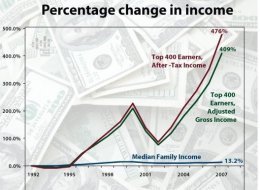
In fact, far from venturing down that road, we’ve been stuck on the road to hyper-capitalism for three decades now. The tea partyers are right to be wary of income redistribution, but if they had even the slightest openness to empiricism, they’d see that the redistribution of the past 30 years has all been upward — radically upward. From 1950 through 1980, the share of all income in America going to the bottom 90 per cent of Americans — effectively, all but the rich — increased from 64 per cent to 65 per cent, according to an analysis of tax data by economists Thomas Piketty and Emmanuel Saez. Because the nation’s economy was growing handsomely, that means that the average income of Americans in the bottom 90 per cent was growing, too — from $17,719 in 1950 to $30,941 in 1980 — a 75 per cent increase in income in constant 2008 dollars.
Since 1980, it’s been a very different story. The economy has continued to grow handsomely, but for the bottom 90 perc ent of Americans, it’s been a time of stagnation and loss. Since 1980, the share of all income in America going to the bottom 90 per cent has declined from 65 per cent to 52 per cent. In actual dollars, the average income of Americans in the bottom 90 percent flat-lined — going from the $30,941 of 1980 to $31,244 in 2008.
In short, the economic life and prospects for Americans since the Reagan Revolution have grown dim, while the lives of the rich — the super-rich in particular — have never been brighter. The share of income accruing to America’s wealthiest one per cent rose from nine per cent in 1974 to a tidy 23.5 per cent in 2007.
Looking at these numbers, it would be reasonable to infer that when the tea partyers say that they want to take the country back, they mean back to the period between 1950 and 1980, when the vast majority of Americans encountered more opportunity and security in their economic lives than they had before or since. Reasonable, but wrong. As the right sees it, America’s woes are traceable to the New Deal order that Franklin Roosevelt, working in the shadow of the even more sinister Woodrow Wilson, imposed on an unsuspecting people.
In fact, the New Deal order produced the only three decades in American history — the’50s,’60s and’70s — when economic security and opportunity were widely shared. It was the only period in the American chronicle when unions were big and powerful enough to ensure that corporate revenue actually trickled down to workers. It marked the only time in American history when, courtesy originally of the GI Bill, the number of Americans going to college surged. It was the only time when taxes on the rich were really significantly higher than taxes on the rest of us. It was the only time that the minimum wage kept pace (almost) with the cost of living. And it was the only time when most Americans felt confident enough about their economic prospects, and those of their nation, to support the taxes that built the postwar American infrastructure.
Since the ascent of Ronald Reagan, though, America’s claim to being a land of opportunity has become a sick joke. Unions have dwindled; colleges have become unaffordable; manufacturing has gone abroad; taxes on the rich have plummeted; and American infrastructure has decayed.
But the country the right wants to return to isn’t the America that the Greatest Generation built. Judging by the statements of many of the Republican and tea party-backed candidates on next Tuesday’s ballots, it’s the America that antedates the New Deal — a land without Social Security, unions or the minimum wage. It’s the land that the Greatest Generation gladly left behind whey they voted for and built the New Deal order.
All of us should want our country back, but that country should be the more prosperous and economically egalitarian nation that flourished at the time when America was not only the world’s greatest power, but also a beacon to the world.
Harold Meyerson is editor-at-large of American Prospect and the L.A. Weekly. (Washington Post)
http://news.guelphmercury.com/Opinions/Editorials/article/710528
http://www.washingtonpost.com/wp-dyn/content/article/2010/10/26/AR2010102605216.html?hpid=opinionsbox1
Saturday, October 16, 2010
Nyles Kendall: Republicans out of touch with working class

Writing in the Arizona Daily Wildcat, Nyles Kendall exposes the anti-working families agenda of the Republican Party:
Republicans have been riding a wave of increasingly favorable public opinion for the past two years, but their anti-working class agenda will lose them votes at the ballot box this November.
In an interview on MSNBC's "The Last Word," host Lawrence O'Donnell asked Republican National Committee Chairman Michael Steele to specify the amount of the federal minimum wage.
After attempting to change the subject and accusing O'Donnell of "trap playing," Steele, unable to answer the question, declared that the minimum wage was irrelevant, a slap in the face to the country's estimated 980,000 minimum-wage workers.
Steele's days as chairman of the RNC are numbered. He will have plenty of time to learn about the relevance of the federal minimum wage while waiting for his weekly unemployment compensation to kick in.
But Steele is not alone in his indifference to the plight of America's minimum wage worker. Several Republican Senatatorial candidates seemingly agree with the chairman's statements.
Rand Paul of Kentucky, Linda McMahon of Connecticut and Washington's Dino Rossi have all entertained the idea of adjustments to the federal minimum wage. John Raese of West Virginia believes it should be abolished altogether. "I profess that (the) minimum wage be eliminated and we operate on the laws of supply and demand just like we did before the depression," the wealthy businessman said at a candidate forum last month.
Alaskan Tea Party candidate Joe Miller has even suggested that the federal minimum wage is unconstitutional. If he had paid attention in high school civics, he would be aware of the fact that its constitutionality was affirmed in 1941, nearly 70 years ago.
In recent months, Republicans have provided an ailing Democratic Party with plenty of political ammo. Democrats have used Steele's recent statements to hammer the theme that Republicans will repeal the minimum wage. This strategy will undoubtedly prove advantageous this November, given that the Republican Party's base is overwhelmingly blue-collar.
Former Republican Speaker of the House Newt Gingrich added insult to injury last week, urging Republican candidates to portray Democrats as the party of food stamps, a program which currently serves 37.9 million Americans.
Such rhetoric alienates the independent voter as well as the nearly 50 million unemployed people struggling to make ends meet in the current economic recession.
According to a survey conducted by the Public Religion Research Institute, nearly two-thirds of Americans favor increasing the minimum wage to at least $10 an hour. 51 percent of the survey's respondents identified themselves as Republican.
The party's unequivocal opposition to the federal minimum wage, like its intent to extend the Bush tax cuts, only lends credence to the argument that Republicans are far too accommodating to the wealthy.
The federal minimum wage was established in 1938, at the height of the Great Depression, in order to ensure a "minimum standard of living necessary for health, efficiency and general wellbeing." Reducing or eliminating the minimum wage in a recessionary economy is not only economically unsound but immoral.
The Republican Party, far too concerned with serving the interests of corporate bankers and multi-millionaires, has once again proven that it is abysmally out of touch with America's working class.
http://wildcat.arizona.edu/perspectives/republicans-out-of-touch-with-working-class-1.1687255
Thursday, October 14, 2010
Lee Fisher is the clear choice for Ohio voters concerned about jobs and the economy

Cuyahoga Falls, OH ~ “I will not only be a vote for fair and balanced trade [in the U.S. Senate],” said Lee Fisher, Ohio’s Democratic Candidate for U.S. Senate, “I will be a tireless advocate for fair and balanced trade.”
The Coalition for a Prosperous America (CPA) held the Ohio Senate Candidate Forum at the Sheraton in Cuyahoga Falls, Ohio this morning. Candidate Lee Fisher (D) attended and answered voter questions. Candidate Rob Portman was invited but declined to attend due to scheduling difficulties. Mr. Portman did send a surrogate to make a statement and take voter questions back to campaign headquarters.
Fisher accused Rob Portman of helping cause the trade deficit, manufacturing decline and job losses when Portman was U.S. Trade Representative in the Bush Administration. “Rob Portman repeatedly chose not to do anything about currency manipulation when he was in a position to take action,” Fisher said.
Fisher also said that he supports HR 2378 which the House of Representatives passed on September 29, 2010 to neutralize foreign government currency manipulation. He favors tax credits for manufacturing in America to offset foreign value added taxes. Fisher further said he supports the TRADE Act which would evaluate past trade agreements for efficacy and plot a course for a new trade policy that would balance trade.
“We appreciate Mr. Fisher’s support for balanced trade,” said Michael Stumo, CEO of CPA. “The Great Recession was caused in large part by ill-conceived trade policy at the federal level. We are dedicated to educating candidates, voters and elected officials so they make smart decisions on future trade policy.”
Other speakers at the event were Jacki Adams (Northeast Ohio Campaign for American Manufacturing); Bruce Cain (Xcel Mold & Machine, Canton, OH); Peter Yoder (Yoder Agriculture); John Wagner (Tri-County AFL-CIO); Joe Logan (farmer and CPA Co-Chair for Agriculture); and Tim Burga (Ohio AFL-CIO).
“Voters need to know where their candidates stand on trade issues to make intelligent decisions on November 2,” continued Stumo. “Ohio has been particularly hard hit with job and manufacturing losses caused by federal trade policy. Only by a single-minded focus on balanced trade can we achieve full employment and sound growth for our manufacturers and farmers.”
Wednesday, October 13, 2010
Levin and Donnelly show leadership on manufacturing and trade issues

House Ways and Means Committee Chairman and Michigan Representative Sandy Levin and Congressman Joe Donnelly of Indiana held a roundtable discussion about trade and manufacturing issues at Mack Tool and Engineering in South Bend. Also in attendance were representatives from Nucor, Reliable Metalcraft, Value Tool and Engineering, and the Alliance for American Manufacturing.
One of the most pressing concerns for Hoosier manufacturers voiced by attendees was the advantage Chinese competitors gain from that country’s unfair manipulation of their currency.
Supported by Donnelly and Levin, H.R. 2378, The Currency Reform for Fair Trade Act, passed the House of Representatives by a broad bipartisan vote on September 29 and seeks to level the playing field for our small businesses by targeting exchange rate misalignment between the U.S. Dollar, Chinese Yuan and other major trading partners in order to reduce the unnatural comparative advantages that command economies like China’s can use against market economies.
“It’s past time to crack down on Chinese currency manipulation. It is estimated that China’s continued undervaluing of its currency has already cost 55,000 Hoosier jobs, with 6,000 of those in north central Indiana alone,” said Donnelly. “I will continue to work in Congress with leaders like Chairman Levin to fight against Chinese currency manipulation and other unfair trade policies that are bad for Hoosier businesses and bad for working families.”
A report by the Alliance for American Manufacturing and the Economic Policy Institute conducted a study examining job loss due to currency manipulation and found that 6,000 jobs have been lost in Indiana’s Second Congressional District. China undervalues its currency by anywhere from 15 to 40 percent, keeping the prices of its exports artificially low, undercutting the market for American-made goods, and forcing American businesses to close.
“U.S. workers and businesses can compete if the playing field with China is level, and I am proud to have worked with Joe Donnelly to get this landmark legislation to safeguard U.S. industries and U.S. jobs from China’s currency manipulation approved by the U.S. House,” said Rep. Sander Levin, Chairman of the Committee on Ways and Means. “Standing up for U.S. jobs and forcing China to play by the rules is vital to Indiana and throughout our nation’s manufacturing base.”
Saturday, September 11, 2010
Jack Conway: A Fighter for Kentucky's Working Families

The choice is clear in the Kenucky U.S. Senate. A fighter for Kentucky's working families like Jack Conway or Rand Paul who wants to ship our jobs overseas, privatize Social Security and legalize drugs.
Jack Conway has a record of getting results for the people of Kentucky. Elected in 2007 as Attorney General, Jack previously served as Deputy Cabinet Secretary and Deputy General Counsel in Governor Paul Patton’s administration from 1996 to 2001. While there he worked to craft economic development programs that put the Commonwealth on a path to prosperity and the landmark 1997 higher education reform bill, which won national acclaim for propelling Kentucky’s institutions of higher learning into the 21st century.
Jack Conway has always considered the highest duty of a public servant to be protecting those who are unable to protect themselves. Since the voters of Kentucky elected Jack as Attorney General, his office has increased Medicaid fraud
prosecutions by 600%, saving over $100 million for Kentucky taxpayers. He has advocated for consumers and saved Kentucky families over $100 million from proposed utility rate increases. Jack has sued the big oil companies for gas price gouging, and in his first year as Attorney General, increased elder abuse and neglect investigations by 300%. He followed through on his commitment to prosecute child predators and crack down on Internet crimes when he created a Cybercrimes Unit, which has initiated numerous child pornography investigations, eliminated over 68,000 illegal images and videos from the Internet, and continues to conduct trainings for police and prosecutors across Kentucky.
Simultaneously, Jack reduced costs in the Attorney General’s office by 26%, setting a strong example by taking a pay cut and giving his official vehicle back to the state. Jack has a proven record of combating waste, fraud, and abuse in government.
As a United States Senator, Jack has a plan to create jobs, cut the deficit, and restore accountability to Wall Street and Washington. Jack has a plan, which is estimated to create 731,000 jobs nationwide and 10,975 jobs in Kentucky through a
combination of tax credits and small business lending. He has already identified $430 billion in savings that can be recouped for taxpayers by: shutting down offshore tax shelters and closing loopholes in the corporate tax code that encourage companies to invest and ship jobs overseas; making big pharmaceutical companies negotiate with Medicare for lower prices on prescription drugs; and eliminating waste, fraud, and abuse in Medicare. Additionally, Jack will fight for Wall Street reform that puts taxpayers first, protects consumers, and cracks down on the big banks by preventing any institution from ever again becoming “too big to fail.”
Jack is a proud Kentuckian. His father, Tom, was born on a family farm in Western Kentucky’s Union County. He put himself through law school at night at the University of Louisville, while teaching history and coaching at Fairdale High
School. Jack’s mother, Barbara grew in up in Louisville’s South End, the daughter of a union blacksmith.
Jack Conway holds an undergraduate degree in public policy from Duke University and a law degree from The George Washington University. Conway is married with one daughter.
In contrast to Jack Conway's advocacy for working families, Rand Paul is a proven enemy of Kentucky workers.
From the AFL-CIO NOW Blog:
Kentucky State AFL-CIO President Bill Londrigan doesn’t pull punches when he talks about the Bluegrass State’s Tea Party-backed Republican U.S. Senate candidate. Speaking to a sun-baked crowd at Paducah’s 35th annual Labor Day picnic Monday, he warned:
A vote for Rand Paul is a vote for the continuation of the economic nightmare now facing workers across Kentucky. Vote like your job depends on it—because it does.
The state AFL-CIO unanimously endorsed Democrat Jack Conway over Paul, whose anti-union views earned him a $2,500 donation from the National Right to Work Committee.
Conway is the state’s attorney general. An ophthalmologist, Paul is the son of Rep. Ron Paul (R-Texas). Dr. Paul is bad medicine for Kentucky’s working families, according to Londrigan.
He supports privatizing Social Security and increasing the retirement age for Social Security eligibility. He supports so-called free trade agreements like NAFTA, which are responsible for shipping millions of good-paying American jobs overseas.
When it comes to jobs safety, a vital issue for state’s coal miners and other workers, Londrigan said Paul’s response to catastrophic mine accidents and oil rig explosions is:
“‘accidents happen.” In Rand Paul’s world, corporations should be completely unregulated so they can cook the books and undermine our economy.
Londrigan went on to highlight the differences between Rand Paul’s world and the world in which most Kentucky workers live.
In Rand Paul’s world, Social Security is a burden and not a reward for a lifetime of hard work and sacrifice and something to be handed over to Wall Street.
In Rand Paul’s world, the budget deficit is a monstrous problem, but tax cuts for the rich are still a priority.
In Rand Paul’s world, teachers and the Department of Education are a hindrance to learning. In Rand Paul’s world, farm subsidies are a handout. In Rand Paul’s world, lowering workers’ wages is the way out of a recession.
And in Rand Paul’s world, property rights trump civil rights. If you’re an ordinary American, a hard-working Kentuckian, you can’t afford to live in Rand Paul’s world.
Jeff Wiggins, a United Steelworkers (USW) members and president of the Paducah-based Western Kentucky Area Council, said Kentucky union families are a vital element in the fight to send Conway to the Senate and Paul back to his practice.
But Wiggins, the Labor 2010 coordinator for western Kentucky, also says working families must be mobilized. He doubts Paul will win many union votes, but says the Republican is hoping for the next best thing: a slew of union card-carrying Kentuckians will forget that the GOP’s gospel of greed caused the recession, will blame hangover hard times on the Democrats and will show their disdain by not voting.
Wiggins has a message for potential non-voting union members:
If you stay home on Nov. 2, you’ll be helping the same sort of people who tried to push labor off the cliff under Bush. Democrats like Jack Conway want to throw us a rope and pull us away from the edge. But Republicans like McConnell and Paul still want to push us off.
http://blog.aflcio.org/2010/09/10/workers-dont-fit-into-rand-pauls-world/
Saturday, September 04, 2010
Study Finds No Economic Benefit from "Right-to-Work" laws

Michael Wasser, a research intern at American Rights at Work, dismantles the arguments for right-to-work (for less) laws:
Proponents of so-called “right-to-work laws,” such as the U.S. Chamber of Commerce and the National Right to Work Committee, argue that they create a more business-friendly environment and lead to economic growth for states and their residents.
But is that really the case?
As Jack Hough noted in a recent Smart Money article, new research suggests that the supposed economic benefits of right-to-work laws may be little more than useful rhetoric for the law’s supporters. http://www.smartmoney.com/personal-finance/employment/do-labor-unions-hurt-employment/#
Because of a provision added to the National Labor Relations Act in 1947 through the Taft-Hartley amendments, states may pass right-to-work laws. These laws ban agreements stipulating that all employees represented by a union have to pay dues. Right-to-work laws currently are on the books in 22 states.
The new research on the economic effects of these laws comes from Lonnie Stevans, Professor of Information Technology and Quantitative Methods at Hofstra University. He compared the business formation and economic growth of right-to-work states with non-right-to-work states using recent data from the U.S. Small Business Administration. Stevans controlled for variables like education levels, population changes, and type of employment in the states to accurately measure the relationship between right-to-work laws and economic growth. http://www.bepress.com/rle/vol5/iss1/art25/
As the Smart Money article states:
Stevans found that RTW [right-to-work] states had lower per-capita income for workers, but higher income for business owners, than non-RTW states… According to Stevans, there’s little evidence of a ‘trickle down’ of benefits in RTW states from business owners to workers.
He also didn’t find evidence that right-to-work legislation affects the states’ employment rates.
Professor Stevans’s findings cast a pall of doubt over the economic claims of right-to-work supporters. Though their talking points may remain unchanged, the fact is right-to-work laws do not improve the economic viability of states and their workers. And as John Adams once said, “Facts are stubborn things…”
http://americanrightsatwork.org
Labor Day 2010: America's Workers Losing Ground

The well-respected Economic Policy Institute provides some alarming statistics for us this Labor Day. There is no doubt at it. Our middle and working class in the USA faces a bleak future thanks to many years of deregulation, union-busting, so-called free trade agreements, outsourcing and tax breaks for the rich. It is time for American workers to fight back and demand an end to tax policies which allow corporations to profit for shipping our jobs overseas. The Employee Free Choice Act has to become law. We need to repeal the Bush tax cuts for the rich. President Obama must impose a 10% tariff on imports to reduce the massive trade deficit which is destroying U.S. jobs. We must hold our Democratic President and Congress accountable but the solution is definitely not to elect more reactionary Republicans with absolutely nothing to offer America's middle class.
Labor Day by the Numbers
Anna Turner
September 3, 2010
(Note that all numbers are current as of September 3, 2010. States numbers are current as of August 20, 2010.)
JOBS NEEDED TO REGAIN PRE-RECESSION EMPLOYMENT RATE: 11 MILLION
Change in total jobs in August 2010: -54,000; Change in jobs in August 2010, excluding 114,000 temporary U.S. Census Bureau jobs lost that month: +60,000
Change in private-sector jobs in August 2010: +67,000
Change in public-sector jobs in August 2010: -121,000; Change in public sector jobs, excluding 114,000 temporary U.S. Census Bureau jobs lost that month: -7,000
Change in size of the labor force in August 2010: +550,000
Accounting for population growth, number of workers that should have been added to the labor force since December 2007: +3.7 million; Actual change in the size of the labor force since December 2007: +241,000
The number of unemployed workers for every job opening: 5
Total jobs lost since the start of the recession: -7.6 million
Manufacturing jobs lost since the start of the recession: -2.0 million (14.9% of sector’s jobs)**
Construction jobs lost in the recession: -1.9 million (25.1%, one in four construction jobs)**
UNEMPLOYMENT RATE: 9.6%
Number unemployed: 14.9 million (up from 7.7 million in December 2007)**
Portion of unemployed who have been jobless more than six months: 42%
Portion of unemployed who have been jobless more than a year: 21.9%**
Underemployment rate: 16.7%; Number of under- and unemployed, marginally attached, and involuntary part-time workers: 26.1 million
Male unemployment: 10.6%; female unemployment: 8.6%
White unemployment: 8.7%; black unemployment: 16.3%; Hispanic unemployment: 12.0%
Average weekly unemployment benefit in July: $306; Average weekly benefit in July for those who still receive the $25 provided by the American Recovery and Reinvestment Act: $331;
STATES WITH DOUBLE-DIGIT UNEMPLOYMENT IN JULY 2010: 11
Highest unemployment rate: Nevada, 14.3%; lowest: North Dakota, 3.6%
Highest black unemployment rate: Michigan with 23.7%; Highest Hispanic unemployment rate: Nevada with 18.4%
Total change in number of state and local government jobs over the last two years (since the peak in August 2008): -282,000 jobs
CHANGE IN PRODUCTIVITY 2002-07: +11%; CHANGE IN MEDIAN COMPENSATION 2002-07: -0.6%**
Annual private-sector nominal hourly wage growth in the year before the recession: 3.4%; Nominal wage growth in 2010/2009: 1.6%
Share of income growth going to the top 1% of households from 1989 to 2007: 56%; Share of income growth going to the bottom 90% of households: 16%
Ratio of average CEO’s pay to typical worker’s pay in 1973: 27 to 1; Ratio right before the recession in 2007: 275 to 1
OVERALL SOCIAL SECURITY BENEFIT CUT FROM CURRENT RETIREMENT AGE INCREASE (65 to 67): 13%
Average annual Social Security benefit for a retiree: $14,050
Share of retirees receiving all their income from Social Security: more than 1 out of 4
Share of retirees receiving more than half of their income from Social Security: 69%
Share of older Americans (age 45 onwards) who prematurely took out funds from their 401(k), IRA, or other retirement investments in 2009: 18%; Share of Hispanic older Americans who did so: 22%; Share of African American older Americans who did so: 26%
Total decline in assets from pensions, 401(k)-style accounts and IRAs between 2007 and 2009: $1.5 trillion
Number of workers whose employers do not offer a retirement plan: 78 million (49%)
UNEMPLOYMENT RATE FOR YOUTH (16-24): 18.1%
Share of youth (16-24) who are neither employed nor enrolled in school:* 17.9%
Number of young people (16-24) who have dropped out of the labor force since the recession began:* 1.1 million
Youth (16-24) share of the labor force in August 2010:* 13.6%; Youth share of the unemployed:* 25.6%
Unemployment rate for young (16-24) black workers in January 2010: 32.5%; For young Hispanic workers: 24.3%; For young white workers: 15.2%
The average student debt of graduates from private four-year institutions in 2000/01: $16,906; Average debt in 2007/08: $25,350
ANNUALIZED RATE OF GDP GROWTH, 2nd QUARTER, 2010: 1.6%
When the American Recovery and Reinvestment Act will cease to provide any boost to growth rate of GDP: Last quarter of 2010
Change in size of the economy since the start of the recession 31 months ago:* shrunk 1.3%
Number of full-time equivalent jobs supported through expansion of unemployment insurance since the beginning of the recession: 1.7 million
* Data is newly updated by EPI but links to original reports with older numbers.
** EPI calculation using Bureau of Labor Statistics
http://www.epi.org/publications/entry/labor_day_by_the_numbers1
Labor and Democratic Party leaders backing Charlie Crist

Florida Governor Charlie Crist is picking up strong Democratic backing in his independent campaign for U.S. Senator. Al Lawson, Florida Senate Minority Leader, is the latest prominent Florida Democrat to embrace the Crist campaign. Labor leaders and Democratic activists are leaning toward Crist as they become increasingly skeptical of the Kendrick Meek candidacy. Meek is consistently running third place in the polls and has a questionable track record on working families issues.
Five Florida Teamster locals have announced their support for the U.S. Senate candidacy of Crist. Endorsing Crist are Local 79 in Tampa, Local 173 in Bradenton, Local 385 in Orlando, Local 947 in Jacksonville and Local 991 in Mobile, Ala., with Teamster members in the Panhandle.
The Teamsters decided to endorse Crist because of his commitment to creating jobs and rebuilding the economy, issues vital to working families.
"Charlie Crist is a good governor who cares more about people than party," said Local 79 President Ken Wood. "He stood up for President Obama's stimulus package when he thought it would help working families in Florida, even though he took a lot of flak from his own party for doing so."
Crist supports relief for pension funds hurt by Wall Street's meltdown, said Wood, who is also an International Vice President for the union and President of Joint Council 75.
Crist also advocates the Express Carrier Employee Protection Act, which would put employees of all express package delivery companies under the same labor law, Wood said.
"We need to elect politicians who listen to us, who represent us and who protect us, and that's exactly what Charlie Crist has done for Florida's working families," Wood said.
In contrast, an essay from Working Life questions Kendrick Meek and his votes as a Congressman for free trade agreements. Instead of protecting American jobs, Meek has sided with the U.S. Chamber of Commerce and others who want more outsourcing and free trade deals.
Why Should Labor Support Kendrick Meek?
11/15/2009
When NAFTA was passed in 1993, I, and others, argued that the labor movement should mount primary challenges to every Democrat who voted for the legislation,” writes Jonathan Tasini in the on-line Working Life. “After all, labor correctly saw NAFTA as the underpinning for a trade policy that would hasten the evolution of a global economy based on one thing: the search for the lowest wage possible. And that is the kind of trade policy that we now have. The labor movement did nothing, however, to hold the pro-NAFTA Democrats accountable.
“Then came CAFTA -- the Central American Free Trade Agreement. It passed thanks to 15 Democrats who voted for the deal in the House. I argued back then that those 15 Democrats should be held accountable for that vote. But, again, they were not. And, in response, the labor movement has had to fight more NAFTA-style trade agreements.
“Which brings us to the current moment. I pointed out recently that Rep. Kendrick Meek dropped his support for a very important piece of legislation spearheaded by Rep. Mike Michaud. There is only one reason Meek did so -- he is running for the U.S. Senate seat in Florida and wants to attract corporate money to his campaign. Ringing up dollars from sources that are not friendly to the labor movement is not a new thing for Mr. Meek: he took in thousands of dollars from Wal-Mart (as did, in fairness, other Democrats). And it is likely his sudden change of heart on the TRADE Act will aid him again, as reported by CongressDaily PM [Thursday]:
“‘The U.S. Chamber of Commerce this week wrote to Rep. Kendrick Meek, D-Fla., thanking him for removing his name from a bill that could force the United States to renegotiate several existing and pending trade agreements...
“‘"The Chamber appreciates your record of support for agreements that have opened foreign markets for U.S. exports and created American jobs," Josten wrote. He added his group thanked Meek for recognizing the Michaud bill "would have the opposite effect."’
“Let's be clear -- the Chamber is doing what it does in the current electoral financing system. I don't fault the Chamber. Those are the rules, as bad as they are and as much as they pervert our system of governing.
“The real question is: what will labor do? If Meek continues to get labor support -- financial and otherwise -- will that not simply signal other Members of Congress that they can do as they please and jump ship on critical labor legislation? I think the answer is obvious.
“The question should be: who does Meek work for? The people? Or the Chamber?”
https://www.editorsguild.com/LaborNews.cfm?LaborNewsid=2393
Friday, September 03, 2010
ADA Calls For Action To Boost Manufacturing Jobs

The Labor Day celebration will be muted for 27 million Americans and their families
this weekend”, said Michael J. Wilson, National Director of Americans for Democratic Action,commenting on unemployment data issued today, by the Bureau of Labor Statistics (BLS). The rest of us can honor American workers and go to the beach, but we as a Nation should be taking further robust action to put Americans back to work.
The BLS reported that the total non-agricultural employment jobs declined slightly by
54,000 in August, while the overall unemployment rate remained at 9.6%. Federal government employment fell, as 121,000 temporary workers hired for the decennial census completed their work. On the other hand, the private-sector payrolls increased by 67,000 workers. This summer,the unemployment rate of 9.6% meant that 14.8 million would-be workers were unemployed.
An additional 2.2 million were marginally attached to the workforce, 1.1 million more were so discouraged by long-term job searches that they stopped looking for work, and 8.8 million took part-time work when they wanted and needed a full-time job. In other words, the real rate of unemployment was 16.7%, or 27.2 million individuals needing full-time jobs.
The only bright spots in the report were the growth of health care by 28,000, mining
by 8,000, professional and business services by 17,000, construction up 19,000, and retail trade gained 8,000 among motor vehicle and parts dealers.
On the other hand, manufacturing employment declined by 27,000 and offset the small but important gain of 36,000 manufacturing jobs in July . Employment of fabricated metals rose by 9,000. The country added 183,000 manufacturing jobs since December 2009. Our future prosperity rests on the restoration of manufacturing. America’s economic greatness has rested on making things, not on Wall Street’s shuffling of money by trading in obscure credit default swaps and derivatives that almost sent our economy over a cliff. According to the Congressional Joint Economic Committee, the federal government, working in partnership with businesses, local and state governments, resulted in 11 straight months of growth in the manufacturing industry, creating 135,000 jobs over the six months preceding August.
Wilson advocates ADA’s agenda calling for additional actions that Congress should
take to put our nation’s unemployed back to work in good middle-class jobs, restoring our manufacturing base, boosting our exports, and refurbishing our infrastructure. “The federal government, working with private industry, state and local governments and together can support the growth of U.S. manufacturers for the markets of the future. Blather about the deficit is hypocritical nonsense and counter-productive until we have achieved full employment, so our workers are taxpayers”, he said.
Congress needs to develop, and the executive branch needs to implement, a National
Clean Energy Technology Export Strategy, and help U.S. firms find and navigate foreign markets. We should be building wind turbines, battery technologies, and solar panels to power our homes and businesses, not importing them from low-wage countries. To do so, Congress can help the clean-tech manufacturing sector to reduce production costs and encourage innovation, investment, and productivity. Clean energy technology exports could increase by $40 billion per year and create more than 750,000 jobs by 2020.
A Clean Energy Technology Manufacturing and Export Assistance Act of 2010, H. R. 5156, passed the House on July 28, but is currently languishing in the Senate.
Congress should close tax loopholes and enforce corporate accountability by
preventing corporations from shipping jobs overseas and sticking American taxpayers with the bill. By passing HR 1586, the $26 billion jobs bill, Congress has already closed one loophole, the misused foreign tax credit, which encouraged corporations to shift jobs and profits off shore. But those who blocked a more robust jobs bill should be ashamed.
Another example: the House passed, but the Senate has held up, extending TANF Emergency Funds beyond September 30. The program employed 250,000 parents and youth, providing them with much needed job skills.
Congress should raise $100 billion by repealing myriad corporate deductions, like
those for the oil industry, which interfere with sound investment decisions and shift the tax burden onto working people. By enacting President Obama’s proposals to crack down on off-shore tax avoidance by corporations, Congress could raise $122 billion in a decade, according to Citizens for Tax Justice.
Wilson reiterated his call for effective job creation, restoration of America’s
manufacturing base, while fully paying for our action agenda by restoring basic tax fairness.
http://www.adaction.org/
Where are the economic patriots to save America ?
.jpg)
Tula Connell writes at Our Future:
AFL-CIO President Richard Trumka yesterday described the upcoming elections this way:
This election is about economic patriots, and it’s also about corporate traitors.
Economic patriotism resonates among working people and the millions ofAmerica's jobless workers--and corporate traitors is an all-too apt description of many in Big Business, such as anti-patriotic corporations moving jobs out of this country. A graf buried in an a New York Times article on Wall Street this week me hard:
Just last week, Paul S. Otellini, chief executive of Intel, said at a dinner at the Aspen Forum of the Technology Policy Institute that "the next big thing will not be invented here. Jobs will not be created here."
Mr. Otellini has overseen two big acquisitions in the last two weeks — the $7.7 billion takeover of the security software maker McAfee and the $1.4 billion deal for the wireless chip unit of Infineon Technologies. If he is true to his word, those deals will most likely lead to job cuts in the United States, not job creation.
Otellini is not an outlier. Reports this week say Citigroup--which received $45 billion in taxpayer bailout funds--now is creating 12,000 jobs. In China.
Also this week, a new report shows that between November 2008 April 2010, the CEOs of the top 50 job-cutting companies made $598 million in compensation. The top 50 layoff firms reported a 44 percent average profit increase for 2009, the Institute for Policy Studies report said.
Calling out such behaviors and casting them for what they are--unpatriotic, anti-American--can help us take back the ground grabbed by reactionaries for so long, with the Tea Party just the latest manifestation of such warped usage of the red, white and blue.
Patriotism means more than lip service. It means taking action to ensure that working families have the good jobs they need to support their families--creating an environment that's worthy of our American Dream.
http://www.ourfuture.org/blog-entry/2010093502/wanted-economic-patriots-save-american-dream
The Great American Stickup exposes how Wall Street and corrupt politicians destroyed our economy

Check out this review from Nation Books:
In The Great American Stickup, celebrated journalist Robert Scheer uncovers the hidden story behind one of the greatest financial crimes of our time: the Wall Street financial crash of 2008 and the consequent global recession. Instead of going where other journalists have gone in search of this story—the board rooms and trading floors of the big Wall Street firms—Scheer goes back to Washington, D.C., a veritable crime scene, beginning in the 1980s, where the captains of the finance industry, their lobbyists and allies among leading politicians destroyed an American regulatory system that had been functioning effectively since the era of the New Deal.
This is a story largely forgotten or overlooked by the mainstream media, who wasted more than two decades with their boosterish coverage of Wall Street. Scheer argues that the roots of the disaster go back to the free-market propaganda of the Reagan years and, most damagingly, to the bipartisan deregulation of the banking industry undertaken with the full support of "progressive" Bill Clinton.
In fact, if this debacle has a name, Scheer suggests, it is the "Clinton Bubble," that era when the administration let its friends on Wall Street write legislation that razed decades of robust financial regulation. It was Wall Street and Democratic Party darling Robert Rubin along with his clique of economist super-friends—Alan Greenspan, Lawrence Summers, and a few others—who inflated a giant real estate bubble by purposely not regulating the derivatives market, resulting in the pain and hardship millions are experiencing now.
The Great American Stickup is both a brilliant telling of the story of the Clinton financial clique and the havoc it wrought—informed by whistleblowers such as Brooksley Born, who goes on the record for Scheer—and an unsparing anatomy of the American business and political class. It is also a cautionary tale: those who form the nucleus of the Clinton clique are now advising the Obama administration. http://www.newsweek.com/2010/08/29/how-obama-got-rolled-by-wall-street.html
http://www.nationbooks.org/book/213/The%20Great%20American%20Stickup
Sunday, July 25, 2010
Bernie Sanders: No More Tax Breaks for Billionaires

Sanders Op-Ed: No More Tax Breaks for Billionaires
By Sen. Bernie Sanders
July 20, 2010
Four facts:
One: The United States is in the midst of the worst economic downturn since the 1930s. More than 16 percent of working-age Americans are unemployed or underemployed. Long-term unemployment is the highest on record. Millions of people have lost their homes, their savings and their pensions.
Two: The United States today has a $13 trillion national debt and a record-breaking deficit. Last year alone, the federal government spent more than $186 billion just paying interest on that debt. We are leaving our children and grandchildren a huge financial obligation which will not only impact them personally but affect the well-being of the entire country as we compete in the global economy.
Three: The United States has the most unequal distribution of wealth and income of any major country. Today, the top 1 percent earns more income than the bottom 50 percent and the top 1 percent owns more wealth than the bottom 90 percent. During the Bush years, when the middle class saw a $2,200 decline in median family income, the 400 wealthiest families saw their income more than double while their effective income tax rates were slashed almost in half over the past 15 years. The wealthiest 400 Americans have now accumulated $1.27 trillion in wealth, while the highest paid 400 Americans had an average income of $345 million in 2007 alone. As a result of Bush tax policy they pay an effective tax rate of 16.6 percent, the lowest on record. (Warren Buffet, one of the richest people on earth, has often commented that he pays a lower effective tax rate than his secretary).
Four: Last March, Dan Duncan, the wealthiest person in Houston, Texas, died and left his family some $9 billion dollars. For the first time since 1916, Mr. Duncan’s heirs will pay no inheritance taxes. Not one dime. This occurred as a result of President Bush’s $1.35 trillion dollar tax break enacted into law in 2001.
In other words, at a time when this country has a devastatingly high rate of unemployment, a huge debt, massive unmet needs and a growing gap between the very richest people and everyone else, we are currently providing enormous tax breaks to millionaire and billionaire families. This is absurd!
Under the Bush tax law, inheritance taxes eliminated this year would be restored to the pre-2001 estate tax rates in 2011 unless Congress acts. Needless to say, a united Republican Party and a few Democrats, representing the interests of the very wealthy few, are working hard to either eliminate the inheritance tax forever or make it as low as possible. (In fact, in 2006, every Republican but two voted in favor of eliminating the estate tax completely).
A century ago, President Teddy Roosevelt, a good Republican, called for a graduated inheritance tax on wealthy estates. In 1916, Congress passed that law. Here is what Roosevelt said in 1910.
“The absence of effective state, and, especially, national, restraint upon unfair money-getting has tended to create a small class of enormously wealthy and economically powerful men, whose chief object is to hold and increase their power. The prime need is to change the conditions which enable these men to accumulate power which is not for the general welfare that they should hold or exercise… No man should receive a dollar unless that dollar has been fairly earned. Every dollar received should represent a dollar’s worth of service rendered – not gambling in stocks, but service rendered. The really big fortune, the swollen fortune, by the mere fact of its size acquires qualities which differentiate it in kind as well as in degree from what is passed by men of relatively small means. Therefore, I believe in a graduated income tax on big fortunes, and in another tax which is far more easily collected and far more effective – a graduated inheritance tax on big fortunes, properly safeguarded against evasion and increasing rapidly in amount with the size of the estate.”
I agree with Teddy Roosevelt. What he proposed is exactly what The Responsible Estate Tax Act that I have introduced (along with Senators Harkin, Whitehouse, Franken and Sherrod Brown) will do. Specifically, my bill exempts the first $3.5 million of an inheritance from paying any federal estate tax whatsoever. Doing this means that 99.7 percent of Americans who receive an inheritance would not pay one penny in federal estate taxes. This legislation would impact only the very wealthy – the top three-tenths of 1 percent.
Under my bill, the value of estates above $3.5 million and below $10 million would be taxed at 45 percent; the value of estates above $10 million and below $50 million would be taxed at 50 percent; and the value of estates above $50 million would be taxed at a rate of 55 percent, the same as the 2001 level before the Bush tax cuts. Further, my bill includes a10 percent surtax on the value of estates above $500 million ($1 billion for couples). According to the Joint Committee on Taxation, this legislation, over a 10-year period, would bring in over $315 billion – a good step forward in addressing our national debt.
This legislation would do something even more important. In the midst of these enormously difficult times, it makes clear that we are one country and that all Americans must accept shared responsibility. It is immoral and unfair that, while the middle class struggles to survive, millionaires and billionaires get tax breaks.
Saturday, July 24, 2010
U.S. Rep. Debbie Halvorson has a plan to boost U.S. manufacturing

From Trade Reform.Org
Congresswoman Debbie Halvorson (D-Illinois) understands that America’s economic prosperity depends on the success of our manufacturing sector. Over the last few decades millions of American manufacturing jobs have moved overseas. We need to jumpstart our nation’s manufacturing sector with policies that will create new, good-paying manufacturing jobs here in America.
Halvorson’s plan to boost American manufacturing:
Implement a National Strategy for Manufacturing
Halvorson is a co-sponsor of the National Manufacturing Strategy Act (H.R. 4692), legislation she is working to pass that would direct the President to submit a National Manufacturing Strategy to Congress every four years. The plan would include legislative proposals to train the manufacturing workforce, boost productivity, incentivize growth, and create new jobs.
Modernize Workforce Investment Programs
Halvorson believes with the proper training, American workers can outperform foreign competitors. Unfortunately, too many of our workers are not trained in the skills needed to compete in a rapidly changing global economy. This is why Halvorson co-authored and introduced the AMERICA Works Act (H.R. 4072), legislation to modernize federal workforce training programs to better prepare participants for high-tech jobs in the manufacturing sector.
Halvorson has heard from manufacturing employers that we must do more to provide educational options for our youth for careers in manufacturing. She is working with manufacturers to fight for increased investment in K-12 career and technical education, as well as in STEM (science, technology, engineering, and math) education.
End Unfair Trade Practices
Halvorson is fighting unfair Chinese trade practices that put American manufacturers at a competitive disadvantage. For years China has undervalued its currency, which allows Chinese producers to sell its goods in the U.S. market at artificially low prices, undercutting American manufactures. Halvorson is a co-sponsor of the Currency Reform for Fair Trade Act (H.R. 2378), legislation that will respond to countries that manipulate their currency by accounting for their artificially low costs.
Halvorson is also fighting to ensure the U.S. government purchases goods manufactured in America. She is a co-sponsor of the Reciprocal Government Procurement with China Creates American Jobs Act (H.R. 5312), which will limit the U.S. government from purchasing goods made in China until the Chinese government allows procurement of goods made in the United States.
Tax Incentives for American Manufacturing and Clean Energy
Tax Relief for Manufacturers: Halvorson has led the way in sponsoring legislation that incentivizes manufacturers to make capital investments. Halvorson introduced the Bonus Depreciation and Enhanced Expensing Extension Act (H.R. 4311), legislation that extends tax incentives that allow manufacturers to more quickly recover the cost of purchasing new equipment and machinery. Provisions from Halvorson’s bill were signed into law by the President and are already in effect. Halvorson is also proposing additional investment tax credits that allow manufacturers to immediately deduct the cost of new equipment and machinery purchases.
Tax Incentives for U.S. Expansion: Halvorson is also proposing new federal tax incentives through the Economic Development Agency for manufacturers that choose to expand a current facility or open a new facility in the United States instead of overseas. These incentives will match state and local incentive packages.
Clean Energy Tax Credit: Halvorson supports the Security in Energy and Manufacturing Act (H.R. 5041), which extends a tax credit for investments in clean energy manufacturing projects. The tax credit gives priority to projects that manufacture (not just assemble) clean energy components in the United States.
Mechanical Insulation Tax Credit: Halvorson authored the Mechanical Insulation Installation Incentive Act(HR 4296), a 5-year tax incentive for non-residential building owners to install mechanical insulation above industry standards into new construction/retrofit projects to be more energy efficient. This bill will save $47 billion over 5 years in energy costs and support 89,000 jobs annually across the country.
Increase Access to Capital for Manufacturers through Loan Guarantees
Halvorson believes that small and medium sized manufacturers should have the resources they need to grow and hire new workers. With credit markets still very tight, many manufacturers are having difficulty accessing the capital they need to expand, even manufacturers with strong credit histories. Halvorson proposes the creation of a new loan guarantee program under the Department of Commerce that will guarantee private loans made to small and medium sized manufacturers who implement job creating expansion plans.
http://www.tradereform.org/2010/07/creating-the-next-generation-of-manufacturing-jobs/
Saturday, July 17, 2010
Proposed Social Security Cuts Will Hurt The Middle Class

Despite the fact that Social Security is fully funded through 2039, there have been calls to cut Social Security benefits in an effort to reduce the long-term budget deficit. A new analysis from the Center for Economic and Policy Research (CEPR) finds that three of the most common proposals to cut Social Security would have a substantial negative impact on low- and middle-income families.
“There is a great deal of talk in policy circles about cutting Social Security, but very little discussion of the financial situation of those affected by the cuts,” said Dean Baker, co-director of CEPR and an author of the report.
The study, “The Impact of Social Security Cuts on Retiree Income,” analyzes three of the most common proposals for reducing Social Security benefits and calculates the implied cut in benefits and income for various age groups and income quintiles of near and current retirees. The proposals examined are the adoption of progressive price indexation, raising the retirement age to 70 by 2036 and reducing the annual cost-of-living adjustment or COLA by 1.0 percent below the rate of inflation. It is worth noting that these proposals would only have a negligible impact on the deficit over the course of the next 10 years.
The analysis of the proposed cuts show:
The most frequently suggested PPI formula would imply cuts in benefits of 6.2 percent for a household in the in the middle income quintile between the ages of 45-49 in 2007 and 9.6 percent for a household in the middle quintile between the ages of 40 and 44 in 2007.
Raising the normal retirement age 70 in 2036 would result in a 4.0 percent reduction in benefits for workers between the ages of 50 and 54 in 2007 and a 10.0 percent reduction for workers between the ages of 40-44.
Reducing the COLA by 1.0 percent would result in a benefits cut of 12 percent for a retiree at age 75 and more than 20 percent at age 85.
For retirees in the bottom income quintile at age 85 who were between the ages of 55 and 59 in 2007, reducing the COLA by 1.0 percent implies a 14.6 percent reduction in income and a cut of 16. 5 percent for retirees in the bottom quintile at age 85 between the ages of 40-44.
“The vast majority of near-retirees will rely on Social Security for most of their income in retirement,” said Baker. “All of these proposals will result in significant cuts in income for low- and/or middle-income families.”
http://www.cepr.net/documents/publications/ss-2010-07.pdf
Sunday, June 20, 2010
Worker-owned cooperatives help restore the American dream

A recent report by the New America Foundation calls attention to worker-owned cooperatives and employee ownership of corporations as a means of expanding economic prosperity.
Heath McCulloch writes:
Economic downturns typically galvanize interest in alternative economic models, and this one is no exception. Employee ownership is one such alternative that has, in recent months, captured the attention of the mainstream media including CNN Money, The New York Times, Time Magazine, Christian Science Monitor, The Economist, and Business Week. Employee ownership leaders and asset-building practitioners share a common goal of broadening access to ownership opportunities, but these strategies are still off the radar screen of the asset-building movement. It’s time to give them the attention they deserve.
Asset-building advocates have long included investment strategies – home and business ownership, in particular – as critical steps along a path to financial security for low-income working families, but we have typically focused on individual ownership strategies. Notable exceptions include recent Ford Foundation investment in the exploration of shared equity homeownership as a way to enable low-income families to build home equity while preserving public subsidies and keeping housing affordable over time and the Annie E. Casey Foundation has supported a national work group focused on the asset-building value of shared business ownership.
Today, there are new windows of opportunity to bring funders, investors, advocates and practitioners of shared business ownership strategies into the broader asset-building movement. Two common employee ownership strategies are a logical place to start—
Employee Stock Ownership Plans (ESOPs) and worker-owned cooperatives. These strategies have long supported U.S. workers – across the wage spectrum – to build financial assets through ownership of an equity stake in the businesses where they work. ESOPs are one type of employee benefit plan that buys and holds company stock on behalf of workers. Worker-owned cooperatives are companies that are owned and democratically managed by their employees.
The National Center for Employee Ownership reports that more than 10,500 ESOP plans cover almost 13 million workers and over $900 billion in U.S. company assets. ESOPs hold great potential as asset-building vehicles for U.S. workers, at all wage levels: the average ESOP participant has $47,000 of savings in the ESOP alone (the majority of ESOP companies offer additional, direct contribution retirement plans, typically 401(k)s).
Worker cooperatives represent a small segment of the U.S. economy: According to a recent federally-funded study, 223 worker coops in the U.S. employ 2,380 full-time worker-owners. But they are particularly relevant to asset-building advocates because they are increasingly being established in low-income communities, targeting low-skilled and/or immigrant workers. For example, the Cleveland Foundation, City of Cleveland, business and university leaders have established the Evergreen Cooperative Development Fund to create a network of coops targeting low-income community residents. In the San Francisco Bay Area, two nonprofits – WAGES and Teamworks – are supporting networks of worker-owned cleaning cooperatives owned by immigrant workers.
http://assets.newamerica.net/blogposts/2010/shared_business_ownership_an_asset_building_strategy-32264
Senator Bernie Sanders of Vermont introduced legislation last year to expand employee ownership and worker-owned cooperatives. The text of the bill introduced by Senator Sanders reads as follows:
United States Employee Ownership Bank Act - Directs the Secretary of the Treasury to establish the United States Employee Ownership Bank to foster increased employee ownership and greater employee participation in company decision making throughout the United States. Authorizes the Bank to make loans, on a direct or guaranteed basis, and which may be subordinated to the interests of all other creditors, to employees to purchase a company through an employee stock ownership plan or eligible worker-owned cooperative which is at least 51% employee owned, or will become so as a result of Bank assistance. Authorizes the bank also to allow:
(1) a company that is less than 51% employee owned to become at least 51% employee owned; and
(2) allow a company that is already at least 51% employee owned to increase the level of employee ownership, expand operations, and increase or preserve employment.Amends the Worker Adjustment and Retraining Notification Act to require the employer, if it orders a plant or facility closing in connection with the termination of its operations there, to offer its employees an opportunity to purchase such plant or facility through an employee stock ownership plan or an eligible worker-owned cooperative that is at least 51% employee owned. Exempts from such requirement an employer that orders a plant closing:
(1) but will retain the plant assets to continue or begin a business within the United States; or
(2) intends to continue the business conducted at such plant at another plant within the United States. Amends the Community Reinvestment Act of 1977 to authorize the appropriate federal financial supervisory agency, in assessing and taking into account the record of a financial institution during an examination, to consider capital investments, loans, loan participation, technical assistance, financial advice, grants, and other ventures undertaken by the institution to support or enable employees to establish employee stock ownership plans or eligible worker-owned cooperatives that are at least 51% employee-owned.
http://www.opencongress.org/bill/111-s2914/show
A very interesting history of the role of labor unions in creating worker cooperatives is provided by the Worker-Ownership Institute:
The concept of employee ownership in North America dates back to the settlement of the continent by men and women breaking the land to establish their farms and building their own stores and workshops. Unlike Europe, where peasants were bound to the land and ownership of productive property was concentrated in the hands of the few, in North America a society of relative equals who owned their own productive assets was built: farms, tools, workshops, stores, etc.
The independent farmers, shopkeepers and artisans who populated revolutionary North America yielded in the latter part of the 19th century to the rapid growth of the large corporations and increasing concentration of ownership. The farmers set about establishing cooperatives to buy their supplies…seed, fertilizer, etc….and to process and market their products jointly. The co-ops were owned by the farmers who bought from them and supplied them. Today family farming in the United States and Canada is sustained by an elaborate network of purchasing, processing and marketing cooperatives that provide the economics of large scale production within family ownership of land. Even electricity in large parts of rural America is provided by co-ops.
Consumer co-ops took hold in town and country. Credit unions, mutual savings banks and mutual insurance companies are owned by their depositors or policy holders, not by large companies, and provide lower rates and patronage dividends to their owners.
The early unions, such as the Knights of Labor in the 1870s and 1880s, and the craft unions in the 1880s and 1890s, sought to do the same by sponsoring worker cooperatives in which workers pooled their tools and resources to compete with the growing corporations.
For the better part of a century, the growth of worker co-ops was stymied by a structural problem. Those co-ops that failed in the market disappeared for the obvious reasons. But those that succeeded disappeared also. The problem lay in the design of ownership: each member owned one equal share. If the co-op did well, all shares appreciated in value. When founding members wanted to retire, new workers could not afford to buy the retiring members’ shares. So success was as fatal as failure because retiring members sold to outside buyers, and the cooperatives were converted into conventional corporations.
Despite this difficulty, the concept of co-ops was revived regularly in crises as a means to put the unemployed back to work. The Depression generated hundreds of co-ops; the oldest surviving worker-owned businesses of any size in the United States, the plywood co-ops in the Pacific Northwest, were purchased by their employees to avert shutdowns beginning in the 1930s.
But cooperatives gradually disappeared from labor’s agenda as industrialization advanced. While setting up co-ops was realistic in the traditional crafts, it was hard to see how it could work in mass production. How do you start up a cooperative steel mill or auto plant? After the turn of the century, radicals in the labor movement, like the Industrial Workers of the World before the First World War, or the CIO unions in the 1930s, focused on fighting the bosses instead of replacing them. The real economic gains from collective bargaining so far outweighed the hypothetical benefits from production cooperatives that, by the 1950s, the concept had virtually disappeared as a subject of union interest.
http://web.archive.org/web/20060112230115/www.workerownership.org/history.html
Unions have once again embraced the concept of worker co-ops. In October 2009, The United Steel Workers Union, North America's largest industrial trade union, announced a new collaboration with the world's largest worker-owned cooperative, Mondragon International, based in the Basque region of Spain.
Worker co-ops and employee owned companies contribute to restoring opportunity and security for the American middle class. For one thing, employee owned enterprises in the USA are going to be far less likely to outsource, lay off workers and move to China.
Thursday, June 17, 2010
Schauer pushes for fair trade with China at House hearing

Congressman Mark Schauer (D-MI) was invited yesterday to testify before the House Ways and Means Committee about current trade policies with China. During his testimony, Schauer pushed for action on his bipartisan legislation (HR 5312) to stop wasting U.S. taxpayer dollars on goods that are made in China, while it continues to block American goods from its own government contracts.
“When will we play tough? When will we get it?” asked Schauer. “At the very least, we need to show China that we are willing to be strong until they open their procurement markets to us. American workers can build anything if they’re given half a chance to do it. We can’t afford to continue to let China eat the lunches of American workers.”
Currently, goods that are produced in China are being used for government contracts in the United States across multiple industries – such as manufacturing, construction and renewable energy – instead of goods produced by American workers and businesses. Since China has blocked American goods from its own government contracts, Schauer’s bill would level the playing field and make sure taxpayer-funded projects create jobs for U.S. workers.
According to a recent report from the Economic Policy Institute, 2.4 million American jobs have been lost or displaced as a result of the growing trade deficit with China since it joined the World Trade Organization (WTO) in 2001. During that time, the State of Michigan lost 67,800 jobs, including 4,700 in the 7th district alone, due to unfair trade with China.
A copy of Schauer’s testimony is available below:
Mr. Chairman, Ranking Member Camp, members of the Committee - it’s a pleasure to come here to discuss our trade issues with China. I appreciate the invitation and look forward to working with the Committee on these issues.
I’m pleased that the committee is examining the indigenous innovation issue, because it is perhaps the best example we have of China overtly favoring its captive industries. Because China is not an open society, there is little we can do except count the missing jobs, unless we are willing to take a strong stand against favoritism as evidenced in China’s indigenous innovation initiative. My legislation is one tool that can be used to discourage China from continuing to go down this path.
Although the committee is examining a number of issues today, I’d like to focus on the patent unfairness of China’s government procurement policy, as contrasted with the U.S.’s open procurement policy.
Although I represent a manufacturing state that has longstanding concerns with China, my most recent involvement in this issue started rather innocently. This year, I was provided a bag of Census promotional materials. As is my custom, I inspect the labels of the product to determine the country of origin.
The first article was this hat. Now, we all get hats from every group in our district, and I proudly display a number of hats in my Congressional office.
Of all the hats I’ve ever received, I’ve never seen one of as poor quality as this. I can’t imagine anyone wearing this hat. I was shocked to see that this hat was made in China. I wasn’t shocked because the quality was poor; I was shocked because I couldn’t believe that our Census was procuring promotional goods from China.
In the same package of goods, there was a Census 2010 keychain – you guessed, “Made in China.”
I was outraged that our taxpayer dollars were going to our competitors, and I really hit the ceiling when I realized that China shut out US firms from its $580 billion stimulus plan. Something is fundamentally wrong here when a trading relationship is a one-way street that drives jobs out of the US.
When I began talking about my concerns with this procurement publicly, I received an email from the Census. To the extent I understand it – and I’m not certain that I do - the Census seems to believe that these articles were “substantially transformed” by an American company adding the words “Census 2010” to these Chinese goods. The email also contained an explanation stating that “it is extremely difficult to find vendors that sell entirely U.S. made products.”
That answer is unacceptable – if U.S. vendors exist AT ALL, there needs to be a damn good reason why they didn’t get this work.
The Census’s reasoning here is circular: they can’t find a U.S. firm to make the hats, because they don’t give contracts to U.S. firms to make the hats. Well, as I am inclined to do, I looked into this: in my own office I found this, and this, and this (showing U.S.-made hats). All of these are U.S.-made hats of recent vintage.
I also spent about 3 minutes on the internet and came up with a number of options to have these goods made in the U.S. There is no question but that there is sufficient U.S. manufacturing capacity to make these goods, so what went wrong and how did this money find its way to China? We’re still looking into this issue, but it’s clear that something went wrong, especially when the American Chamber of Commerce in China is reporting that U.S. companies – even U.S. companies that have operations in China – are being shut out of that market.
China is playing us for fools regarding the Government Procurement Agreement – the GPA. Upon joining WTO in 2001, China said it would sign the GPA as soon as possible. [noted in USCBC July 2009 “PRC Government Procurement Policy, page 4]. Nine years later, that still hasn’t happened. The U.S.-China Business Council notes in its 2010 White Paper that there has been zero progress on China submitting a commercially-meaningful accession offer to the GPA. It would be interesting to know how many billions of taxpayer dollars have gone to China during this 9-year waiting period.
When they do submit an offer, you can bet that it will be full of exceptions that will end up costing American jobs.
So, when will we play tough? When will we get it? At the very least – the very least - we need to show China that we are willing to be strong until they open their procurement markets to us.
I’ve offered one way of addressing this issue, and that is to cap the amount of US government procurement of Chinese goods to the amount of American goods purchased by the Chinese government.
My bill, H.R. 5312, includes a provision that requires the Secretary of Commerce to perform both a legal and factual analysis of whether China has opened its procurement practice to U.S. goods. Since China isn’t a transparent society, we need more than China’s signature to be assured that they, in fact, are buying U.S. goods.
Under H.R. 5312, the International Trade Administration would report the total value of American goods procured by the Chinese government. The Secretary of Commerce would then certify the amount of that year’s cap for US procurement of Chinese goods – in short, a dollar out, a dollar in. We need this type of basic fairness to bring jobs back to America.
The Economic Policy Institute estimates that we’ve lost 2.4 million American jobs since China joined the WTO in 2001, and that doesn’t include 2009, which was probably a very good year for the Chinese. Will this program be easy to administer? Perhaps it presents challenges, but there are 2.4 million American families that want us to face those challenges.
To a casual observer, it might look as if there are sufficient laws on the books to favor U.S. goods, but it is apparent that the current laws have not been sufficient to stem the flow of jobs heading out. I suspect that the exceptions and waivers have swallowed the rule, and it’s time to reexamine this relationship. At the very least, if we take some positive action, China may understand that it needs to put forth a meaningful accession offer to the GPA, and they’ll stop this “indigenous innovation” program.
There’s a right way to do this. Secretary LaHood travelled to China to tell them that rolling stock for our new railroad investments needs to be made in the U.S., and that waivers won’t be granted. That’s the right message.
American workers can build anything if they’re given half a chance to do it. Earlier I showed you the worst ballcap I’ve ever seen – here is the best one … made right here in the U.S.A. in Newark, New Jersey. Anyone involved in this industry knows that there is sufficient U.S. capacity to make these hats and keep these jobs in the United States.
We can’t afford to continue to let China eat the lunches of American workers through currency manipulation, “indigenous innovation,” and other means.
Monday, June 14, 2010
Kathy Dahlkemper on the benefits of health care reform

New Health Care Rule Delivers on Promise to Keep Existing Plans
by Congresswoman Kathy Dahlkemper (D-PA)
Monday, 14 June 2010
WASHINGTON—Western Pennsylvanians who like and want to keep their health care plans can be reassured that the Affordable Care Act will protect their existing coverage and provide them new consumer protections that will make their health insurance better. The U.S. Departments of Health and Human Services, Labor and Treasury today issued a new regulation under the Affordable Care Act on “grandfathered” (or existing) health plans that will protect the rights of those who want to keep their insurance.
“During the health care debate, I told concerned citizens that if they liked their health insurance, they could keep it under the new reform. Today, we are delivering on that promise,” Rep. Dahlkemper said. “The new regulation protects your ability to keep your insurance and provides new benefits and consumer protections to make your coverage even better. Consumers want more choice and more control when it comes to their health insurance, and we’re giving that to them through the new health care reform.”
The rule announced today ensures that consumers can keep their current plan if they like it. It also gives these consumers new benefits, including:
No lifetime limits on coverage for all plans,
Ending the insurance company practice of rescinding coverage when people get sick and have previously made an unintentional mistake on their application; and
Rep. Dahlkemper’s Young Adult Healthcare provision which offers parents the option to keep their adult children up to age 26 on their insurance plan.
“Grandfathered” plans include those that existed on March 23, 2010. Plans will lose their “grandfather” status if they choose to significantly cut benefits or increase out-of-pocket spending for consumers. Those in plans that make such changes will gain new consumer protections under the Affordable Care Act.
Most of the 133 million Americans with employer-sponsored health insurance through large employers will maintain the coverage they have today. Large employer-based plans already offer most of the comprehensive benefits and consumer protections that the Affordable Care Act will provide to all Americans this year and in the future, such as preventing lifetime limits on coverage.
People who work in smaller firms and those who purchase their own insurance—both of whom change insurers more often than those covered through large employers—will enjoy all of the benefits of the Affordable Care Act when they choose a new plan. These Americans also will benefit from the new competitive Exchanges that will be established in 2014 to offer individuals and workers in small businesses with greater choice of plans at more affordable rates—the same choice of plans as members of Congress.
For the vast majority of Americans who get their health insurance through employers, additional benefits will be offered, irrespective of whether their plan is grandfathered, including:
No coverage exclusions for children with pre-existing conditions; and
No “restricted” annual limits (e.g., annual dollar-amount limits on coverage below standards to be set in future regulations).
For a comprehensive fact sheet, check out the link below.
http://dahlkemper.house.gov/images/stories/2010-6-14_Grandfather_fact_sheet.pdf
Saturday, April 24, 2010
New book by economist explains why "Free Trade Doesn't Work"

In his latest book, "Free Trade Doesn't Work: What Should Replace it and Why" Ian Fletcher, renowned California Economist and Adjunct Fellow at the U. S. Business & Industry Council, takes a hard look at the problems of free trade and its disastrous affect on the U.S. economy.
Unlike many books written in political jargon and confusing cross-semantics that only economists and bankers can understand, this book is focused on bringing important information and details to the average citizen. You will learn the real facts about why politicians keep denying there is a problem when America is sinking in an ever-growing ocean of debt. How the U.S. will not be able to regain its power on the world market until it moves from the industrial infrastructure that it currently is caught in, and more.
This great book explains in detail why free trade beliefs are unrealistic and the steps that must be taken by the nation to become powerful and strong in this changing work dynamic. After a short review of the history of free trade, the book will discuss politics and semantics that have left most average people lost in a fog of indecipherable, encrypted codes.
Economist Ian Fletcher provides the proactive steps that the American people are in a position to take in detail and how you can affect the political climate and understand the effects of economic globalization. Different trade regulations, pacts, and policies are discussed and after reading, you will have a clear understanding of how your life is affected by NAFTA, the Trans-Pacific Partnership and more.
To get access to this most forthright book, you will want to buy a copy of "Free Trade Doesn't Work: What Should Replace it and Why" today! Find information and details at the California Economist, Ian Fletcher, Releases New Book on Problems of Free Trade check out http://www.freetradedoesntwork.com now!
Saturday, March 27, 2010
Will Obama begin to fight offshoring of U.S. jobs ?

Roger Bybee argues that standing up to Benedict Arnold CEO's is a winning strategy for President Obama and the American middle class. The full essay which appeared in the March 26 edition of In These Times is worth a read.
Bybee writes:
Public support for moving against the relocation of jobs to low-wage states is broad, now including Republicans, the college-educated, and, I would venture, more than a few Tea Party types. Here are summaries of some of the most important studies:
77 percent of Americans oppose the outsourcing of jobs to foreign nations, according to Pew Research. "The U.S. public is nearly unanimous in its support of requiring that both labor (93 percent) and environmental standards (91 percent) be included in trade agreements," according to the Chicago Council on Global Affairs. In ranking the importance of possible foreign policy goals, 76 percent of Americans gave the top rating to "protecting the jobs" of the country's workers, according to the same poll.
"A large majority—68 percent—of those surveyed in a new Fortune poll says America's trading partners are benefiting the most from free trade, not the U.S." The explanation for the current economic slowdown most frequently cited by respondents: "U.S. companies sending jobs overseas where labor is cheaper," says Fortune magazine.
An AP-Yahoo News poll conducted mostly in April 2008 "found that most Americans have a negative view of trade agreements." Of those polled, 64 percent said that increasing trade between the United States and other countries has hurt the economy, while just 22 percent said it has helped.
"By greater than six-to-one (61 percent to 9 percent), the public says free-trade agreements result in job losses rather than in new jobs," according to a Pew study. "A solid majority (56 percent) says that free trade makes wages lower in the United States.... A majority of independents, or 52 percent, had a negative view of free trade, compared to 50 percent of Democrats and 43 percent of Republicans."
A University of Maryland/Knowledge Networks poll found that 53 percent of the American public is critical of U.S. government trade policy and wants greater efforts to improve the lives of workers at home and abroad, and to protect the environment.
"In 1997, 58 percent of college graduates said globalization had been good for the U.S. while 30 percent said it had been bad, according to a poll conducted for the Wall Street Journal and NBC News," Greg Ip reported in the Journal. "When the poll asked a similar question this past March, opinion had flipped: 47 percent of graduates thought globalization was bad and just 33 percent thought it was good."
GO AFTER 'BENEDICT ARNOLD' CEOs
This opposition is not new, it has just reached a critical mass where the major media can no longer totally ignore it or merely mock it as "protectionist." For example, NAFTA was opposed by 64 percent of Americans, but was promoted by the full weight of the Clinton administration, corporate America, Mexico, and virtually all of mainstream media including all but two or three of daily papers then in existence.
Similarly, the Permanent Normalization of Trade with China in 2000 generated the opposition of 79 percent of the public, according to a Harris poll (4/00). But again, an all-out lobbying campaign by the Clinton-Corporate America team prevailed—including $26.5 million for a single fundraising event.
Clinton was able to get away with those kinds of shameless anti-worker ploys because the economy was producing some wage increases and generating jobs during his term. But Obama walked in after eight years of George Bush and zero job growth and with wages falling, and some 7.8 additional job losses following the Wall Street meltdown.
American workers are in no mood to see their communities decay before their eyes while their tax dollars help send Whirlpool to Mexico, or Chrysler, which after receiving government "bailout" dollars also moved some of its U.S. operations to Mexico.
If Obama wants to get serious about jobs and recouping the sharp drop in enthusiasm among working people, he needs to challenge what John Kerry once called "Benedict Arnold CEOs."
http://www.inthesetimes.org/working/entry/5751/will_bolder_obama_be_willing_to_lash_out_on_job_relocations
Subscribe to:
Posts (Atom)