SHIFT CHANGE - preview from Mark Dworkin on Vimeo.

Sunday, August 26, 2012


Wednesday, May 11, 2011
Does European Left "meltdown" over immigration provide a lesson for U.S. Democrats ?
Left-leaning political parties are rapidly losing ground across Europe. Working class voters have left the Labour Party and other European liberal parties over their support of open immigration policies.
Many Democratic elected officials in the United States, including President Obama, think it is great politics to support amnesty for twelve million illegal immigrants despite massive unemployment. The trends in Europe are warning signs for American Democrats to proceed with caution in dealing with immigration reform.
Toby Young writes at The Telegraph:
Tempting though it is to blame Ed Miliband for Labour’s poor performance in the local and regional elections, I doubt Labour would have fared much better under another leader. As David Goodhart pointed out in The Independent, Labour’s success has traditionally been dependent on an alliance between the traditional working-class and middle-class liberals and that coalition has now collapsed:
Labour has lost around 4 million working-class voters since 1997, and at the last general election, for the first time, Labour’s middle-class vote (in the ABC1 sense) was higher than its working-class (C2DE) vote. To win an election, Labour needs to win back lots of those blue-collar voters; the trouble is that Labour’s middle-class voters, especially the liberal graduates among them, have increasingly divergent values and interests.
The draining away of working-class support isn’t a problem confined to the Labour Party. Left-wing parties all over Europe are facing similar difficulties. Labour was punished by the British electorate last year, polling its lowest share of the vote since 1983, but not as severely as the Social Democrats were by the Swedes, polling their lowest share of the vote since universal suffrage was introduced in 1921. This was the first time in the Social Democrats’ history that it lost two elections in a row. Only 22 per cent of those Swedes in work voted Social Democrat in 2010, a number that fell to 13 per cent in the Stockholm region.
The same picture emerges wherever you look. In the European election in June, 2009, the Left took a hammering. In Germany, the Social Democrats polled just 20 per cent of the vote, their worst result since the Second World War. In France, the Socialist Party only mustered 16.5 per cent, its lowest share of the vote in a European election since 1994. In Italy, the Democrats polled 26.1 per cent, seven percentage points less than they received at the last Italian election. As David Miliband pointed out in a recent lecture: “Left parties are losing elections more comprehensively than ever before. They are fragmenting at just the time the Right is uniting. I don’t believe this is some kind of accident.”
So what are the causes of this meltdown? It’s particularly baffling given that the whole of Europe was adversely affected by the recent problems afflicting the international banking system. One of the reasons socialists believe history is on their side is because they think capitalism is inherently unstable, lurching from one crisis to another. Yet the financial crisis of 2007-08 has sent voters scurrying towards the Right, not the Left. What’s going on?
The obvious answer is immigration. The educated liberal elites who control most Left-wing parties are pro-immigration. Not only do they believe in its economic benefits, they believe in the virtue of diversity as an end itself. The traditional European working classes, by contrast, are suspicious of immigrants and worry about them taking their jobs or – worse – taking money out of a welfare pot they haven’t contributed to. These tensions were containable when the majority of immigrants were from the developed world, but have been brought into sharp relief with the increase in immigration from the Middle East, Africa and Latin America – asylum seekers as opposed to economic migrants. In Sweden, for instance, the proportion of immigrants from less developed countries increased from 13 per cent to 36 per cent between 1980 and 2000. Of the one million immigrants who’ve entered Sweden since 1990, three quarters of them aren’t in full-time employment. These are the welfare free-riders that the Right-wing Sweden Democrats drew attention to in their 2010 election campaign, polling 5.7 per cent of the vote.
On the face of it, mass immigration has been the undoing of leftwing political parties across Europe since it erodes the shared values that are an essential prerequisite of a well-funded welfare state. Why should indigenous, working populations support the high levels of taxation necessary to sustain generous welfare payments if the beneficiaries are people unlike themselves? If they can’t look at a benefit recipient and think, “There, but for the grace of God, go I”, why should they continue to pay such high taxes? This problem was spelt out by David Willetts a few years ago:
The basis on which you can extract large sums of money in tax and pay it out in benefits is that most people think the recipients are people like themselves, facing difficulties that they themselves could face. If values become more diverse, if lifestyles become more differentiated, then it becomes more difficult to sustain the legitimacy of a universal risk-pooling welfare state. People ask: ‘Why should I pay for them when they are doing things that I wouldn’t do?’ This is America versus Sweden. You can have a Swedish welfare state provided that you are a homogeneous society with intensely shared values. In the United States you have a very diverse, individualistic society where people feel fewer obligations to fellow citizens. Progressives want diversity, but they thereby undermine part of the moral consensus on which a large welfare state rests.
In Britain, as in other European states, traditional working class voters no longer trust the Left-wing party to put their interests above those of recent immigrants. In a recent but as yet unpublished YouGov poll, respondents were asked whether Britain now feels like a foreign country. Working-class centre-left voters agreed by 64 per cent to 26 per cent.
But this isn’t the whole of the story. After all, the Left fared equally badly in the recent Finnish elections, yet only 2.5 per cent of the population of Finland are foreign-born, most from Russia, Estonia and Sweden. Earlier this year, the True Finns – Finland’s equivalent of UKIP – polled 19 per cent of the vote, a five-fold increase since 2007. The Social Democrats, by contrast, saw their share of the vote fall from 21.44 per cent in 2007 to 19.1 per cent. The vote-winning policy for the True Finns was their opposition to the Portuguese bail-out and their success could well be a blueprint for insurgent, Right-wing parties across Europe as the crisis in the Eurozone deepens. If working class voters can no longer empathise with those in need in their own countries, as Willetts suggests, it’s likely that they won’t empathise with those in foreign countries, either.
What seems to be happening across Europe is the fracturing of both the state and the super-state as sources of tribal identity. The European Union has only ever commanded the loyalty of the liberal middle classes and as their political alliance with traditional working-class voters collapses it seems increasingly unlikely that the EU will survive the current economic crisis, at least not in its present form. More surprising has been the decline of the state as a unit capable of commanding people’s loyalty. In Scotland, the beneficiary of Labour’s desertion by working-class voters has been the Scottish Nationalist Party and that, too, seems a pattern likely to be repeated elsewhere. Ethnicity in Europe is beginning to trump more abstract sources of collective identity, as it did in the former Soviet Union after the collapse of the Communist control system in 1989. If UKIP changed its name to the England Independence Party it might see a surge in its support comparable to that of the True Finns.
It would be premature to completely write off the Left as a political force in Europe. The most obvious direction for Labour to go in if it wants to win back its traditional working class supporters is to propose tighter immigration controls than those currently being imposed by the Coalition – and my reading of why Maurice Glasman’s “Blue Labour” is gaining traction within the Party is that it would provide the ideological fig leaf to do precisely that. But working class voters might have a hard time trusting Ed Miliband if he suddenly embraces draconian immigration controls.
What the Left needs is an intellectual colossus, someone capable of articulating a vision that re-unites the liberal intelligentsia with the traditional working class and persuades them to put the interests of the collective – whether the nation state or something larger and more abstract – before those of their family and their tribe. Ultimately, the reason for the left’s political failure is the intellectual vacuum at the heart of the Left-wing project, the absence of an intellectually robust alternative to free-market capitalism. In the meantime, Right-wing and nationalist parties will keep on making gains at the Left’s expense.
http://blogs.telegraph.co.uk/news/tobyyoung/100087179/its-not-just-the-labour-party
Many Democratic elected officials in the United States, including President Obama, think it is great politics to support amnesty for twelve million illegal immigrants despite massive unemployment. The trends in Europe are warning signs for American Democrats to proceed with caution in dealing with immigration reform.
Toby Young writes at The Telegraph:
Tempting though it is to blame Ed Miliband for Labour’s poor performance in the local and regional elections, I doubt Labour would have fared much better under another leader. As David Goodhart pointed out in The Independent, Labour’s success has traditionally been dependent on an alliance between the traditional working-class and middle-class liberals and that coalition has now collapsed:
Labour has lost around 4 million working-class voters since 1997, and at the last general election, for the first time, Labour’s middle-class vote (in the ABC1 sense) was higher than its working-class (C2DE) vote. To win an election, Labour needs to win back lots of those blue-collar voters; the trouble is that Labour’s middle-class voters, especially the liberal graduates among them, have increasingly divergent values and interests.
The draining away of working-class support isn’t a problem confined to the Labour Party. Left-wing parties all over Europe are facing similar difficulties. Labour was punished by the British electorate last year, polling its lowest share of the vote since 1983, but not as severely as the Social Democrats were by the Swedes, polling their lowest share of the vote since universal suffrage was introduced in 1921. This was the first time in the Social Democrats’ history that it lost two elections in a row. Only 22 per cent of those Swedes in work voted Social Democrat in 2010, a number that fell to 13 per cent in the Stockholm region.
The same picture emerges wherever you look. In the European election in June, 2009, the Left took a hammering. In Germany, the Social Democrats polled just 20 per cent of the vote, their worst result since the Second World War. In France, the Socialist Party only mustered 16.5 per cent, its lowest share of the vote in a European election since 1994. In Italy, the Democrats polled 26.1 per cent, seven percentage points less than they received at the last Italian election. As David Miliband pointed out in a recent lecture: “Left parties are losing elections more comprehensively than ever before. They are fragmenting at just the time the Right is uniting. I don’t believe this is some kind of accident.”
So what are the causes of this meltdown? It’s particularly baffling given that the whole of Europe was adversely affected by the recent problems afflicting the international banking system. One of the reasons socialists believe history is on their side is because they think capitalism is inherently unstable, lurching from one crisis to another. Yet the financial crisis of 2007-08 has sent voters scurrying towards the Right, not the Left. What’s going on?
The obvious answer is immigration. The educated liberal elites who control most Left-wing parties are pro-immigration. Not only do they believe in its economic benefits, they believe in the virtue of diversity as an end itself. The traditional European working classes, by contrast, are suspicious of immigrants and worry about them taking their jobs or – worse – taking money out of a welfare pot they haven’t contributed to. These tensions were containable when the majority of immigrants were from the developed world, but have been brought into sharp relief with the increase in immigration from the Middle East, Africa and Latin America – asylum seekers as opposed to economic migrants. In Sweden, for instance, the proportion of immigrants from less developed countries increased from 13 per cent to 36 per cent between 1980 and 2000. Of the one million immigrants who’ve entered Sweden since 1990, three quarters of them aren’t in full-time employment. These are the welfare free-riders that the Right-wing Sweden Democrats drew attention to in their 2010 election campaign, polling 5.7 per cent of the vote.
On the face of it, mass immigration has been the undoing of leftwing political parties across Europe since it erodes the shared values that are an essential prerequisite of a well-funded welfare state. Why should indigenous, working populations support the high levels of taxation necessary to sustain generous welfare payments if the beneficiaries are people unlike themselves? If they can’t look at a benefit recipient and think, “There, but for the grace of God, go I”, why should they continue to pay such high taxes? This problem was spelt out by David Willetts a few years ago:
The basis on which you can extract large sums of money in tax and pay it out in benefits is that most people think the recipients are people like themselves, facing difficulties that they themselves could face. If values become more diverse, if lifestyles become more differentiated, then it becomes more difficult to sustain the legitimacy of a universal risk-pooling welfare state. People ask: ‘Why should I pay for them when they are doing things that I wouldn’t do?’ This is America versus Sweden. You can have a Swedish welfare state provided that you are a homogeneous society with intensely shared values. In the United States you have a very diverse, individualistic society where people feel fewer obligations to fellow citizens. Progressives want diversity, but they thereby undermine part of the moral consensus on which a large welfare state rests.
In Britain, as in other European states, traditional working class voters no longer trust the Left-wing party to put their interests above those of recent immigrants. In a recent but as yet unpublished YouGov poll, respondents were asked whether Britain now feels like a foreign country. Working-class centre-left voters agreed by 64 per cent to 26 per cent.
But this isn’t the whole of the story. After all, the Left fared equally badly in the recent Finnish elections, yet only 2.5 per cent of the population of Finland are foreign-born, most from Russia, Estonia and Sweden. Earlier this year, the True Finns – Finland’s equivalent of UKIP – polled 19 per cent of the vote, a five-fold increase since 2007. The Social Democrats, by contrast, saw their share of the vote fall from 21.44 per cent in 2007 to 19.1 per cent. The vote-winning policy for the True Finns was their opposition to the Portuguese bail-out and their success could well be a blueprint for insurgent, Right-wing parties across Europe as the crisis in the Eurozone deepens. If working class voters can no longer empathise with those in need in their own countries, as Willetts suggests, it’s likely that they won’t empathise with those in foreign countries, either.
What seems to be happening across Europe is the fracturing of both the state and the super-state as sources of tribal identity. The European Union has only ever commanded the loyalty of the liberal middle classes and as their political alliance with traditional working-class voters collapses it seems increasingly unlikely that the EU will survive the current economic crisis, at least not in its present form. More surprising has been the decline of the state as a unit capable of commanding people’s loyalty. In Scotland, the beneficiary of Labour’s desertion by working-class voters has been the Scottish Nationalist Party and that, too, seems a pattern likely to be repeated elsewhere. Ethnicity in Europe is beginning to trump more abstract sources of collective identity, as it did in the former Soviet Union after the collapse of the Communist control system in 1989. If UKIP changed its name to the England Independence Party it might see a surge in its support comparable to that of the True Finns.
It would be premature to completely write off the Left as a political force in Europe. The most obvious direction for Labour to go in if it wants to win back its traditional working class supporters is to propose tighter immigration controls than those currently being imposed by the Coalition – and my reading of why Maurice Glasman’s “Blue Labour” is gaining traction within the Party is that it would provide the ideological fig leaf to do precisely that. But working class voters might have a hard time trusting Ed Miliband if he suddenly embraces draconian immigration controls.
What the Left needs is an intellectual colossus, someone capable of articulating a vision that re-unites the liberal intelligentsia with the traditional working class and persuades them to put the interests of the collective – whether the nation state or something larger and more abstract – before those of their family and their tribe. Ultimately, the reason for the left’s political failure is the intellectual vacuum at the heart of the Left-wing project, the absence of an intellectually robust alternative to free-market capitalism. In the meantime, Right-wing and nationalist parties will keep on making gains at the Left’s expense.
http://blogs.telegraph.co.uk/news/tobyyoung/100087179/its-not-just-the-labour-party
Saturday, March 12, 2011
Senator Bill Nelson calls for end of oil profit-gouging

The South Florida Business Journal reports:
Sen. Bill Nelson, D-Fla., said Friday that oil speculators are using turmoil in Egypt and Libya as the latest excuse for “profit-gouging.”
Nelson has made oil speculation a target in the past. On Friday, he sent a letter his fellow senators, asking them to join him in his latest effort: seeking to raise the margin requirements imposed specifically on purely speculative oil futures contracts.
Nelson wants the senators to co-sign a letter to Gary Gensler, chairman of the Commodity Futures Trading Commission, urging him to act quickly to raise the margin requirements on speculative oil futures contracts.
“The latest spike in oil prices is further evidence that our energy markets are no longer governed by actual supply and demand,” Nelson wrote. “Speculators, again, are seizing on political turmoil to drive the price of oil to unwarranted levels. This time, it’s Egypt and Libya.”
Nelson noted in his letter that speculators have increased their betting on future oil price increases by more than 35 percent, while legitimate hedgers have reduced their holdings of oil futures by more than 20 percent since the Egypt crisis began.
“The loser in this game of profit-gouging by speculators is the American consumer,” he wrote. “Higher gasoline prices mean less money for other things. And at the end of the day, the big loser is America’s economy.”
Last year, in the Dodd-Frank Wall Street Reform and Consumer Protection Act, Congress empowered the CFTC to rein in excessive speculation, but rules haven’t been enacted yet. Speculators continue to buy oil with only 6 percent down payments – $6 down on $100 of oil futures. Ordinary investors face 50 percent down payments.
In January, eight U.S. senators called on regulators to reject lobbying by Wall Street and the financial industry aimed at watering down the new rules.
Nelson said in his letter that he would not raise margin requirements on businesses that engage in the hedging of legitimate risk.
http://www.bizjournals.com/southflorida/blog/2011/03/sen-nelson-end-oil-profit-gouging.html
The Shaky Case for Free Trade

Ian Fletcher, an economist with the Coalition for a Prosperous America, refutes the arguments in favor of free trade:
A crisis is a social problem that has started to hurt the middle class.
Now that offshoring of white-collar work has started to sour people on free trade who were blasé about it as recently as the dot-com boom of a few years ago, it behooves us to ask whether free trade really deserves our support. Unfortunately for this policy, as Nobel Laureate Paul Samuelson put it recently, the proposition that the benefits of free trade outweigh its costs is simply "an innuendo," i.e. not provable by either theoretical arguments or empiricial data.
So what's wrong with free trade theory? Criticizing it really breaks down into two separate issues:
1. Proving that free trade isn't necessarily the best policy for a nation.
2. Deciding what is best, if it isn't.
The first involves much easier arguments, and is a logical precondition for the second, so let's look at it first.
What comes after free trade is an immensely complex question. It will be some combination, not deducible in detail today, of a dozen different policy tools. Tariffs, quotas, reciprocity agreements, offsets, fixed exchange rates ala Bretton Woods, limits on international capital flows, national-content requirements, national champions, cartels, tax incentives, environmental laws and wage policy will all be up for grabs.
Deciding this will require a debate of epic proportions, so forgive me for leaving it for later. For now, let's focus on making this debate logically possible by refuting the dogma that free trade will always produce better outcomes than any other policy.
Before anyone asks: I'm well-aware that abandoning free trade is fraught with peril because of the risk that politics will overwhelm rational policy-making and we could end up even worse off. But given the growing perils of free trade itself, we have no choice.
"Trade realism," is the best phrase to describe this critique. It is better than "fair trade" because it speaks solely to the facts of how the world does work and does not get tangled in value-judgments of how it ought to, which allow free traders to duck the question by disputing the values. We need to be discussing economics, not philosophical questions like the relative value of economic freedom vs. economic equality.
The holes in free-trade theory fall into several general categories:
Problem #1: Free trade theory is based on abstractions, not hard data.
Free trade theory, like much contemporary economics, is heavy on deductive arguments which purport to prove that certain things "must" be the case. No other social science is so skewed to theory over empricial data; a sociologist or demographer who reasoned like this would not be taken seriously. There is a whole movement in economics, called post-autistic economics, in revolt against this.
For example, free traders claim that free trade costs America low-quality jobs but brings high-quality jobs in their place, arguing that America has comparative advantage in advanced capital-intensive industries and comparative disadvantage in primitive industries. But the hard data show America losing both kinds of jobs.
And we are told that the savings in cheaper foreign goods outweigh the lost wages involved. And that we gain more from the growth of foreign nations as trading partners than we lose to them as competitors. But there is no hard data that proves this, particularly since the crucial data concerns the long-term, which by definition we have not yet had the opportunity to observe.
Problem #2: What Does Free Trade Theory Promise, Even If It Is True?
Free traders often speak as if free trade were always good for everyone. Then they admit, in the fine print, that it creates winners and losers.
Worse, the winners and losers are not random. Because free trade radically expands the supply of labor competing for the world's finite supply of capital, it radically privileges capital relative to labor, especially when combined with capital mobility and the entry into the world trading system of large formerly-socialist nations like India and China.
Free-trade theory is pretty much exclusively focused on maximizing national income; it doesn't have very much to say about who receives this income. So free trade could, even if free-trade theory is true, make America end up with a larger economy but grossly maldistributed income. Welcome to Brazil.
And remember, even this unhappy outcome is what we get if free trade theory is true, which itself controversial. If it is false, we might get this outcome without all the offsetting benefits we are promised.
Problem #3: Outdated Arguments
Free traders make outdated claims all the time, mostly about how America must win under free trade because we have comparative advantage in high-wage industries due to our superior technological base and superior entrepreneurial spirit. While the latter may still be intact, our advantage in the former is gone in a world where any new technology can be distributed around the world overnight. This is not even considering facts like half the workforce of Los Angeles county being illiterate, as recently reported.
America succeeded under relatively free trade during the Cold War, but that was a world that was half communist or socialist, and much of the rest, like Latin America, practiced an inward-looking economics that did not make them trade competitors with us. So we didn't really have to face the consequences of open competition with the entire world.
We came to believe in free trade in theory because we didn't really have to live up to it. Now we do, and it's a whole new ballgame.
Problem #4: Short-Term vs. Long-Term Arguments
Many arguments for free trade are fallacious because they ignore the time dimension. For example, the argument that free trade is not a threat to American wages because over time, increasing prosperity in foreign countries will drive up wages overseas. This may be true in the long run, but it will take a generation or more at current rates of income growth. This isn't really that hard to quantify from published figures, if one will only make the effort.
Furthermore, free trade theory draws no distinction between maximizing our short-term consumption and our long-term economic welfare. It is entirely possible, within the mathematical equations that define free-trade theory, to vindicate a policy of selling off the country's assets to finance a short-term consumption binge followed by long-term bankruptcy. Billionaire Warren Buffet has written an article about this, as have I.
Problem #5: Failure To Quantify
Free traders often make arguments that sound good until the numbers come in, like:
1. "Free trade is good for America because it means a billion Chinese are now hungry consumers of American products." But we're running a huge trade deficit, not a surplus, with China, unsurprising since most of those Chinese have annual incomes in the hundreds of dollars.
2. "Other nations are rapidly catching up to American wage levels. India, for example, has a middle class of 300 million people." The problem is that the definition of "middle class" in the Indian context is a family income about 1/5 of what it would take to qualify as middle-class in America. Middle-class over there means the middle of their class system, not ours.
3. "Free trade brings us enormous benefits." One of the dirty non-secrets of trade theory is that the actual economic gains from further expanding free trade, in the case of a large and diverse economy like the US, are fairly small.
4. "Offshoring in a tiny phenomenon." Well, it's just getting started and will be big soon enough. Amazing what 25% per year compound growth will do!
5. Free traders tell us we can sustain the trade deficit because foreigners are so eager to invest in our wonderful business climate. They don't admit that most foreign investment just goes for existing assets. Worse, much is mere government debt.
Problem #6: Illogical Comparisons
My favorite example of this is when Bush Secretary of Labor Elaine Chao claimed that the numbers of jobs offshored must be netted against the number of Americans working for foreign-owned companies in the US.
For a start, most of these jobs don't represent new jobs brought to America by foreigners, but merely foreign companies that bought existing American companies. For a second, a net-net comparison would have to either net jobs offshored from America against jobs offshored to America, or net American employees of foreign companies against foreign employees of American companies.
Since a $500 billion-a-year trade deficit dooms either of these comparisons, it is no surprise that they were evaded.
Problem #7: Trying To Have It Both Ways
One minute, free traders are arguing that exports create jobs and that America is on the verge of an export boom. Clinton was fond of this argument. The next minute, they're arguing that the trade deficit, which is what happens when exports don't thrive, doesn't matter.
One minute, they're telling us that America's labor force is so much more skilled than other nations that we may confidently expect to cream off the best jobs in the world economy. The next minute, we're being lectured on how our lack of a competitive labor force is the cause of our import problems and we should only blame ourselves.
One minute, free traders are telling us that America is so superior in competitiveness to foreign nations that it will aways be top dog in wages. The next minute, we're being told to stop being arrogant and face up to the fact that the world isn't our oyster anymore.
Problem #8: Ad Hominem Arguments
Most of these are overt or covert varieties of the following:
"Opponents of free trade are uneducated xenophobic redneck losers."
The basic argument is that free trade is cosmopolitan, cosmopolitanism is good, therefore free trade is good and people only oppose it because they aren't cosmopolitan enough. This flatters globalists by implying that support for free trade is a kind of sophistication akin to knowing which kinds of French cheese to buy.
Why xenophobia, or fear of foreigners, should be a dirty word when foreigners are economic competitors who put Americans out of work, remains unexplained. I for one am a xenophobe, albeit a moderate and reasonable one.
Problem #9: Whatever Doesn't Kill Me Makes Me Stronger
When free-traders are confronted with some sign that America's trade policies are dangerously wrong, they re-interpret it as evidence that America's economy is so strong it can survive even this problem, so the problem can't be a problem after all. For example, America has survived a record trade deficit that would have produced a currency collapse in any other nation, so trade deficits can't matter. But that's just like saying that because the strong constitution of the patient has enabled him to survive cancer, cancer must be OK.
Problem #10: Non-Economic Considerations
In addition to all the problems with free trade as pure economic policy, we must recognize the non-economic problems it causes. Most of these, once one goes beyond obvious cases like narcotics and unsafe foodstuffs, concern the fact that free trade means handing over control over economic necessities to foreigners. The Arab oil embargo of 1973 is one example; the fact that the US military cannot put a single plane in the sky without foreign parts is another.
http://tinyurl.com/4folfts
http://www.tradereform.org
Sunday, February 27, 2011
The Phony "Deficit Hawk" War Against Middle Class

Dean Baker warns of the phony "deficit hawk" war against the middle class safety net at The Guardian:
The people insisting on cuts to social security and Medicare have revved themselves up and are now in high gear. They see their final victory on the horizon, with the possibility of a bipartisan deal involving substantial cuts to both programmes. They argue that the large deficits facing the country make it imperative that we address the long-term budget problem – meaning, the cost of these programmes – immediately.
Before anyone prepares to surrender, it is worth remembering, once again, how we got into the current situation. Before the downturn, the budget deficits were relatively modest. Even with the cost of fighting two wars, the Bush tax cuts and a poorly designed Medicare drug benefit the deficit was just over 1% of GDP in 2007, the last year before the downturn. This was arguably bigger than desired, but a deficit of this size certainly posed no imminent danger to the economy.
Then, the economy ran off the track. The reason was the collapse of an $8tn housing bubble. This bubble was easy to see for people who knew basic economics and third-grade arithmetic. It was also easy to see that the collapse of this bubble would derail the economy and lead to serious downturn. That is why some of us were warning about the bubble as early as 2002.
But where were the current group of anti-deficit crusaders back in 2002-2006, when it might still have been possible to do something to stem the growth of the housing bubble before it reached such dangerous levels? Well, they were crusading against the budget deficit, of course.
Peter Peterson, the Wall Street investment banker who is the patron saint and financier of much of the deficit crusade, was paying for the "Fiscal Wake-Up Tour", which was supposed to alert people to the dangers of the country's budget deficit. This travelling roadshow of policy wonks and economists had nothing to say about the growing housing bubble that was about to explode and sink the economy.
Then, we have the Washington Post, which is continually setting new records for imbalance on this issue, for example, by running six different columns by deficit hawks on the same day. As the bubble grew to ever more dangerous levels, the Post had no room for those warning of the risks it posed. In fact, its main source for information on the housing market was David Lereah, the chief economist of the National Association of Realtors and the author of the book, Why the Housing Boom Will Not Bust and How You Can Profit From It.
The same story can be told about National Public Radio, the major news networks and all the politicians now leading the charge to cut social security and Medicare. When the country actually did face a real economic disaster, these people were nowhere in sight. They were diverting attention to other issues and dismissing those of us who tried to warn of the real danger.
Now that we are experiencing an economic disaster – 25 million people unemployed or underemployed, millions of people facing the loss of their homes, more than 10 million underwater with their mortgages – as a direct result of their incompetence, these same people are telling us again about the urgent need to cut social security and Medicare. The deficit hawks somehow think that their case is more compelling because of the damage done by their incompetence.
It should not work this way. In most lines of work, incompetence is not a credential; it should not be one in designing economic policy either. Anyone who cares to tell us about the urgent need to deal with the deficit should first be expected to tell us how they managed to overlook the growth of an $8tn housing bubble. They should also be expected to tell us why they have a better understanding of the economy now than they did before the collapse of the housing bubble.
Social security and Medicare provide essential supports to tens of millions of retirees and disabled workers. The projections are clear. The financing of social security poses no major problem – it is projected to be fully solvent for almost 30 years with no changes whatsoever. Medicare poses a problem only because the private healthcare system is broken.
Honest people talk about the need to fix the healthcare system. Less honest people scream about the need to reform "entitlements". And they think that the public somehow should listen to them because of their record of incompetence.
http://www.guardian.co.uk/commentisfree/cifamerica/2011/feb/22/economics-economy?
Sunday, January 30, 2011
Joshua Holland: Ayn Rand Railed Against Government Benefits, But Grabbed Social Security and Medicare

Joshua Holland writes at AlterNet and the United Steel Workers blog:
Ayn Rand was not only a schlock novelist, she was also the progenitor of a sweeping “moral philosophy” that justifies the privilege of the wealthy and demonizes not only the slothful, undeserving poor but the lackluster middle-classes as well.
Her books provided wide-ranging parables of “parasites,” “looters” and “moochers” using the levers of government to steal the fruits of her heroes’ labor. In the real world, however, Rand herself received Social Security payments and Medicare benefits under the name of Ann O’Connor (her husband was Frank O’Connor).
As Michael Ford of Xavier University’s Center for the Study of the American Dream wrote, “In the end, Miss Rand was a hypocrite but she could never be faulted for failing to act in her own self-interest.”
Her ideas about government intervention in some idealized pristine marketplace serve as the basis for so much of the conservative rhetoric we see today. “The reason I got involved in public service, by and large, if I had to credit one thinker, one person, it would be Ayn Rand,” said Paul Ryan, the GOP’s young budget star at a D.C. event honoring the author. On another occasion, he proclaimed, “Rand makes the best case for the morality of democratic capitalism.”
“Morally and economically,” wrote Rand in a 1972 newsletter, “the welfare state creates an ever accelerating downward pull.”
Journalist Patia Stephens wrote of Rand:
[She] called altruism a “basic evil” and referred to those who perpetuate the system of taxation and redistribution as “looters” and “moochers.” She wrote in her book “The Virtue of Selfishness” that accepting any government controls is “delivering oneself into gradual enslavement.”
Rand also believed that the scientific consensus on the dangers of tobacco was a hoax. By 1974, the two-pack-a-day smoker, then 69, required surgery for lung cancer. And it was at that moment of vulnerability that she succumbed to the lure of collectivism.
Evva Joan Pryor, who had been a social worker in New York in the 1970s, was interviewed in 1998 by Scott McConnell, who was then the director of communications for the Ayn Rand Institute. In his book, 100 Voices: An Oral History of Ayn Rand, McConnell basically portrays Rand as first standing on principle, but then being mugged by reality. Stephens points to this exchange between McConnell and Pryor.
“She was coming to a point in her life where she was going to receive the very thing she didn’t like, which was Medicare and Social Security,” Pryor told McConnell. “I remember telling her that this was going to be difficult. For me to do my job she had to recognize that there were exceptions to her theory. So that started our political discussions. From there on – with gusto – we argued all the time.
The initial argument was on greed,” Pryor continued. “She had to see that there was such a thing as greed in this world. Doctors could cost an awful lot more money than books earn, and she could be totally wiped out by medical bills if she didn’t watch it. Since she had worked her entire life, and had paid into Social Security, she had a right to it. She didn’t feel that an individual should take help.”
Rand had paid into the system, so why not take the benefits? It’s true, but according to Stephens, some of Rand’s fellow travelers remained true to their principles.
Rand is one of three women the Cato Institute calls founders of American libertarianism. The other two, Rose Wilder Lane and Isabel “Pat” Paterson, both rejected Social Security benefits on principle. Lane, with whom Rand corresponded for several years, once quit an editorial job in order to avoid paying Social Security taxes. The Cato Institute says Lane considered Social Security a “Ponzi fraud” and “told friends that it would be immoral of her to take part in a system that would predictably collapse so catastrophically.” Lane died in 1968.
Paterson would end up dying a pauper. Rand went a different way.
But at least she put up a fight before succumbing to the imperatives of the real world – one in which people get sick, and old, and many who are perfectly decent and hardworking don’t end up being independently wealthy.
The degree to which Ayn Rand has become a touchstone for the modern conservative movement is striking. She was a sexual libertine, and, according to writer Mark Ames, she modeled her heroic characters on one of the most despicable sociopaths of her time. Ames’ conclusion is important for understanding today’s political economy. “Whenever you hear politicians or Tea Partiers dividing up the world between ‘producers’ and ‘collectivism,’” he wrote, “just know that those ideas and words more likely than not are derived from the deranged mind of a serial-killer groupie….And when you see them taking their razor blades to the last remaining programs protecting the middle class from total abject destitution—Social Security, Medicare and Medicaid—and bragging about how they are slashing these programs for ‘moral’ reasons, just remember Rand’s morality and who inspired her.”
Now we know that Rand was also just as hypocritical as the Tea Party freshman who railed against “government health care” to get elected and then whined that he had to wait a month before getting his own Cadillac plan courtesy of the taxpayers.
But, as I note in my book, The Fifteen Biggest Lies About the Economy, that’s par for the course. A central rule of the U.S. political economy is that people are attracted to the idea of “limited government” in the abstract—and certainly don’t want the government intruding in their homes—but they really, really like living in a society with adequately funded public services.
That’s just as true for an icon of modern conservatism as it is for a poor mother getting public health care for her kids.
http://blog.usw.org/2011/01/30/ayn-rand-railed-against-government-benefits-but-grabbed-social-security-and-medicare-when-she-needed-them/
Monday, January 17, 2011
Borderless Economy, Jobless Prosperity - NYTimes.Com

Nancy Folbre, an economics professor at the University of Massachusetts Amherst, explains the jobless recovery at the New York Times blog Economix:
Why has the economic recovery left workers behind? The question keeps coming up, in slightly different versions. As the headline of a recent New York Times article by Michael Powell put it, “Profits Are Booming. Why Aren’t Jobs?” The term “jobless prosperity” – which surfaced in 1993 and again 2002 – now bobs high. http://www.nytimes.com/2011/01/09/weekinreview/09powell.html
Many journalists argue that globalization is partly to blame for historically low rates of job creation over the last year. Companies in the United States are simply less reliant on American workers – and American consumers – than they once were. Maybe they just don’t need us any more. http://economix.blogs.nytimes.com/2011/01/07/comparing-recoveries-job-changes-2/
Few economists like this argument, but even some mainstream savants like Alan Blinder of Princeton University express concern about the effects of offshoring. And the effects of globalization extend well beyond job loss.
As Harold Meyerson pointed out in The Washington Post, a recent Standard & Poor’s report showed that our largest 500 publicly traded corporations get roughly 47 percent of their revenue from outside the country. http://www.washingtonpost.com/wp-dyn/content/article/2010/12/14/AR2010121407006.html
Writing in The Atlantic on “The Rise of the New Global Elite,” Chrystia Freeland provided a vivid anecdotal account of the same phenomenon, letting the chief executive of a green-technology company explain that most of his sales come from outside the United States, and, if he were starting from scratch, most of his workers would, too. A hedge fund manager tells her why the vigorous growth of a new middle class in China and India counterbalances the decline of the American middle class. http://www.theatlantic.com/magazine/archive/2011/01/the-rise-of-the-new-global-elite/8343/
A recent Wall Street Journal article by Burton Malkiel warned against “home-country bias,” urging investors to hedge their bets on the American economy by tilting their portfolios toward emerging markets in developing countries.
A recent Time magazine article by Zachary Karabell referred to the new joblessness as a part of a megatrend toward globalization that we just have to live with.
So much depends on who “we” are.
During the 25 years after World War II, the interests of American investors and workers were closely, though not perfectly, aligned. Productivity increases were passed on in the form of higher wages that, in turn, fueled increasing demand for domestically produced goods and services.
Businesses willingly paid taxes to support public programs designed to improve the education, health and security of the labor force on which they relied.
Back in 1953, Charlie Wilson, the chief executive of General Motors, famously expressed the opinion (often slightly misquoted) that what was good for the country was good for General Motors, and vice versa. I doubt that was entirely true then, but it was certainly more true then than it is today.
Large corporations are no less patriotic now than they were then. But their economic incentives have changed. Facing intensified international competition, they have little reason to care about the nationality of their workers, consumers or investors.
Fans of globalization point to many economic benefits: lower-priced consumer goods, rewards for technological innovation and higher living standards for many workers in developing countries.
But however significant these benefits, the other side of the ledger reveals significant costs arising from political realignment and efforts to escape regulation and taxes.
Jobless growth is only one symptom of increased social conflict, intensified economic inequality and weakened democracy. The prosperity in jobless prosperity exists only for the rich.
http://economix.blogs.nytimes.com/2011/01/17/borderless-economy-jobless-prosperity/?src=busln
Monday, January 10, 2011
"Right-to-work" laws fail to create jobs, lower living standards

Missouri State Senator Timothy Green explains why "right-to-work" laws fail to create jobs and lower living standards. Green wrote the following essay for The Joplin Independent:
Figures do not lie. In his opening address, the president pro tem of the Senate, my Republican colleague Rob Mayer of Dexter, stated, “Unemployment is lower in the 22 states – six of them our neighbors – that have adopted right-to-work laws.”
This is not accurate. In fact, the highest current unemployment in the country, Nevada, is 14.3%, and Nevada is what I call a “right-to-work-for-less state.” Furthermore, the state of Tennessee, through November of 2010, had an unemployment rate identical to Missouri, 9.4%. Of the 22 right-to-work states, several - including Florida, Georgia, Mississippi, North Carolina and South Carolina - also have higher unemployment rates than Missouri.....
Claims that right-to-work-for-less states have added millions of private sector jobs [as Mayer has claimed] are very misleading. Money talks and right-to-work-for-less states like Tennessee ($577 million in 2008 subsidies for one auto plant) and Mississippi ($300 million subsidy in 2007 for another plant) offered huge incentives. These property and sales tax exemptions, income tax credits, infrastructure aid, land discounts, and training grants - not right-to-work laws - played a primary role in those decisions.
Missouri is recovering from a deep national recession, credit crisis, housing collapse and stalled auto sales which are all to blame for the state’s job losses, not Missouri’s stand on union labor. Workers that make less money are plagued with higher poverty and infant mortality rates, have less access to quality health care, and fewer educational opportunities for children.
The facts show that Missouri continues to be a nationally competitive, business-friendly state. [According to] CNBC’s report, "America’s Top State for Business 2010," Missouri enjoys the 5th lowest overall business costs in the nation. According to the Tax Foundation, Missouri has the 5th lowest corporate income tax rate in the country. Missouri also has the third lowest business energy costs in the U.S., according to the Small Business and Entrepreneurship Council. Moreover, Missouri companies also enjoy the 4th lowest commercial electricity costs in the U.S., according to data from the U.S. Energy Information Administration.
A study by the Center for Economic and Policy Research, funded in part by the Ford Foundation, and on whose Board sits Dr. Joseph Stiglitz, a Nobel Prize winning economist, confirms that union employees have higher wages, and are more likely to have employer-provided healthcare and pensions than non-union states. Right-to-work-for-less will bring substantial increases in Medicaid costs to the taxpayer, if union membership declines in Missouri. While 58.5% of the employees of non-union employers have health insurance and 48.5% have employer provided pensions, 77.9% of unionized employees in Missouri have healthcare and 77.3% have pensions. A non-union employee is less likely to have employer provided healthcare than a union employee. Every time there’s an economic recession, a lot of people immediately blame the workers in organized labor. However, if you consider neighboring Illinois, or Minnesota or Wisconsin, they each have a higher standard of living and a better tax base for public schools, fire, police because they’re all unionized states.
Sen. Mayer spoke of allowing the “free market to prevail,” but he then proposed legislation which would prohibit private employers from negotiating an agency shop provision with a union. There is nothing “free market” about such limitations. The facts are that federal law prohibits closed shops where workers are required to join the union before they can be hired. Similarly, workers can never be forced to join a union, union security clause or not. Also, under federal law workers cannot be forced to pay dues for any union political activity.
When right-to-work-for-less laws are passed, real economic data shows that wages and benefits decline for all workers. This law will not help Missouri reverse its severe job losses.
Supporters of right-to-work-for-less in Missouri want to see the majority of workers making minimum wage with no health insurance. They won’t be happy until they turn Missouri into the Mississippi of the Midwest – which has the lowest median household income in the country and one of the lowest percentage of households with health insurance. Labor unions are about dignity and respect in the workplace.
http://www.joplinindependent.com/display_article.php/jyount1294545158
Sunday, January 09, 2011
In These Times: Will Anger Over Offshoring, Free-Trade Deals, Cost Obama Re-election in 2012 ?

Writing at In These Times, Roger Bybee asks if public anger over free trade policies and outsourcing will cost President Obama re-election in 2012:
With nearly 9 out of 10 Americans convinced that the "offshoring" of jobs to Mexico, China, and India was a top reason for job loss and America's struggling economy, how did the Democrats manage to turn November 2 into such a massacre for their candidates?
This is a crucial question for labor, because the Republican gains not only destroyed labor's chances for moving forward on issues like the Employee Free Choice Act on easier union recognition, but also opened the gates for radical attacks on public employees and perhaps the biggest concerted push for "right-to-work" laws banning the union shop since the Taft-Hartley Act in 1947.
Essentially, President Obama and the Democrats failed to offer a credible narrative on the continued economic slump that directly blamed Corporate America for offshoring jobs. The consequences could be huge: Both a loss of faith in the Democrats among working people, and a loss of union membership due to the huge increase in Republican power.
When unemployment is high, the party in power is normally punished in midterm elections. But this was no normal year: Voters were widely and deeply convinced that corporate offshoring of jobs—not just government policy—plays a role in decimating jobs and their communities.
The public is unified as never before across class, educational, and partisan lines about the destructive effects of "free trade" agreements and the offshoring of jobs that it such FTAs promote.
An October Wall Street Journal/NBC News poll reported on by the Wall Street Journal showed the remarkably strong and widespread public anxiety—86% overall—over the export of jobs: “In the recent WSJ/NBC poll, 83 percent of blue-collar workers agreed that outsourcing of manufacturing to foreign countries with lower wages was a reason the U.S. economy was struggling and more people weren't being hired; no other factor was so often cited for current economic ills."
Remarkably, 90% of Republicans--compared with 84% of Democrats--expressed worry in the poll about the economic effects of offshoring. And the level of concern among blue-collar workers was lower than the general level of 86% and substantially below that expressed by professionals and managerial employees, at 95%, probably because blue-collar workers have long been subject to the threat of offshoring.
"The important change is that very well-educated and upper-income people compared to five to 10 years ago have shifted their opinion and are now expressing significant concern about the notion of...free trade," said Bill McInturff, a Republican pollster.
Among those earning $75,000 or more, 50 percent now say free-trade pacts have hurt the United States, up from 24% who said the same in 1999. No doubt the fast-growing phenomenon of offshoring professional jobs helps to explain this shift.
The near-unanimous worry about offshoring (including 90% of Republicans), resentment about US corporations creating jobs overseas but not at home, and the possibility of dividing the Republicans by heavily stressing the offshoring issue—should have created the possibility of a Democratic counter-attack against the Republicans' illogical claims that government spending to stimulate the economy was somehow costing jobs.
But President Obama stepped back from pushing a strong economic narrative that would have pointed out how corporate offshoring was undermining his economic stimulus efforts. Even in staunchly pro-union communities like my hometown of Racine, Wis., Obama barely mentioned the issue of offshoring.
The offshoring issue emerged only when individual Democratic candidates began to highlight the issue with their speeches and TV ads. House candidates attacking "free trade" and offshoring were three times more likely to win than pro-"free trade" Democrats, according to a detailed analysis by Public Campaign's Global Trade Watch. The study also showed a vast explosion in the national importance of the issue as it became a central theme in many elections.
But what lessons, if any, did Obama draw from the massacre in which 63 House seats and 6 Senate seats were lost? He cavalierly turned the very next week to promoting a NAFTA-style free trade agreement with South Korea. The deal is fiercely opposed by the AFL-CIO, and the Economic Policy Institute estimates that it will cost 159,000 US jobs.
Pollster Ruy Teixeira of the Center for America's Progress views Obama's push for the South Korea free-trade aagreement as deepening the estrangement already felt by many working people.
"Trying to run around doing free trade agreements [Obama is also planning such deals with Colombia and Panama] seems counterintuitive," the pollster and analyst stated in an interview. "To a lot of voters, it will seem too cozy with the higher reaches of economic power.
"People would respond better to a more populist tone from the president, given that the party suffered nearly a 30-point deficit among moderate to low-income Democrats on Nov. 2. President Obama may be underestimating how weary people are about losing jobs and what a negative reaction that they will have," Teixeira cautioned.
Still, the issue of offshoring jobs must gain media visibility before elites in both parties must start addressing the issue, argues Jeff Faux, president of the Economic Policy Institute. Thus far, media "gatekeepers"—who share the pro-"free trade" perspective of corporate CEOs and their political allies in both parties—have largely dismissed concern about offshoring-caused job loss as backward-looking protectionism.
That makes it all the more vital for labor and its progressive allies to "re-frame" the issue of preserving America's productive base, saving jobs, and protecting income standards. "The debate has to be framed that it's about the future of the country," Faux stresses. "Right now, it's been framed in the mainstream media as the loss of jobs from bygone era."
But significant obstacles remain to labor and progressives pressing Obama on offshoring.
The Republicans' unwavering, fanatical attacks on President Obama and virtually every reform of the last century will tend to deny progressives the political space to challenge Obama's politically and economically disastrous "free trade" policies. "There will be a definite impulse to circle the wagons because he's under such attack from the Right, and progressives will find themselves in that circle, too," maintains Ruy Texeira.
While Obama may toss progressives an occasional concession on trade issues, he will ultimately have to win back his 2008 voters and convince them that he is sincere and serious about fighting to prevent jobs from being off-shored.
Lori Wallach, director of Public Citizen's Global Trade Watch, makes a persuasive case (Common Dreams.org, 11/3/10) that Obama cannot hope to be re-elected without taking decisive action to stop the tide of offshoring jobs and promoting an alternative "fair trade" model that protects US jobs and workers' rights and the environment around the world.
Without regaining the faith of voters in the industrial Midwest--where unions' numbers are now threatened by the "right-to-work" offensive-- who were crucial to his victory in 2008, it is hard to see any path to an Obama can reelection, says Wallach:
In 2008, Obama only won the election because he won the critical states of Ohio, Pennsylvania, Michigan and Wisconsin by differentiating himself from McCain on trade. It is pretty obvious with Dems and GOP nationwide running against the trade status quo and its job offshoring damage, that if Obama flip-flops now in favor of more job-killing NAFTA agreements, he will lose those states and end up a one-term president.
http://www.inthesetimes.com/working/entry/6820/obamas_weak_narrative_on_job_loss_2_could_have_huge_impact_on_labor_20/
Saturday, January 01, 2011
Post and Courier: The Infrastructure Alarm
From The Post and Courier:
Severe spending restraint is a fact of life for governments at all levels across the land. But if sweeping budget reductions gut our already-insufficient investment in public infrastructure, Americans could end up paying a terrible price for an illusory bargain.
Pennsylvania Gov. Ed Rendell brought that urgent message to Charleston last week. Co-chair of Building America's Future, a bipartisan coalition of elected officials sounding the infrastructure alarm, he said in a visit to this newspaper: "We are in serious danger of our infrastructure collapsing. The threat to public safety is enormous."
An Associated Press story in Wednesday's Post and Courier offered a grim example of that menace. It reported on the struggles of a Goose Creek husband and his children to cope with the March loss of their wife and mother. She was killed when a chunk of asphalt flew through her windshield on I-20 near Heflin, Ala.
Gov. Rendell, formerly the mayor of Philadelphia, joined Charleston Mayor Joe Riley in decrying our decaying infrastructure's detrimental effects on not just safety but quality-of-life issues, including ever-growing traffic congestion and carbon emissions. The second-term governor offered this bottom line: "We've forgotten how businesses grow."
Gov. Rendell served as chairman of the Democratic National Committee from 1999-2001. Now he's teamed up with two prominent Republicans -- outgoing California Gov. Arnold Schwarzenegger and New York City Mayor Michael Bloomberg -- who are his BAF co-chairs.
They correctly cite the growing gap between the infrastructure improvements being made by other economic powers and the U.S. -- and the rising risks that without significant, timely upgrades in our roads, airports and port facilities, we will keep losing critical ground in the global marketplace.
Public infrastructure spending in the U.S. has dropped to less than 2.5 percent of gross domestic product. Some of our key international competitors commit three times as much of their GDPs to this vital purpose.
From a BAF fact sheet: "One-third of America's major roads are in poor or mediocre condition, and 45 percent of major urban highways are congested."
And a trend of particular interest in this port city: "By 2020, every major U.S. container port is projected to at least double the volume of cargo it was designed to handle. Some East Coast ports will triple in volume, and some West Coast ports will quadruple."
America's infrastructure needs aren't confined to transportation and commerce. For example, our overburdened and aging electrical grid increasingly suffers costly brownouts.
On the brighter side, Gov. Rendell pointed out that even in this year's election, with budget-cutting zeal running high, 71 percent of infrastructure initiatives passed, proving that "the American people get it."
He identified "Job One" as "fix it first" -- make necessary repairs to current infrastructure. However, he also stressed that we must move forward on high-speed rail.
Gov. Rendell hailed the concept of a National Infrastructure Bank to generate funds from a variety of sources (tolls, capital bonding, gas-tax increases, leveraging private capital) -- and would allocate money based on merit. He also called for more private-sector investment, while correctly warning that significant public investment will be necessary for many projects.
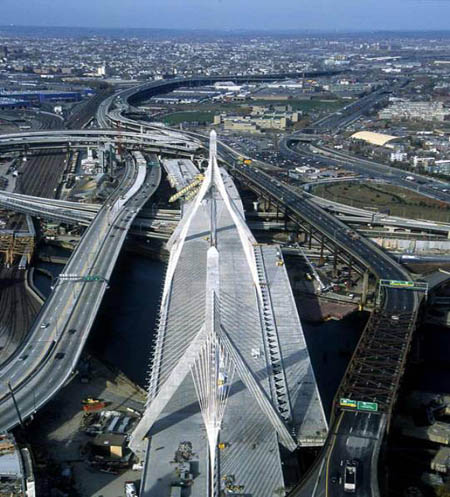
Certainly our own S.C. State Infrastructure Bank, created in 1997, has helped deliver such investment -- and played a crucial role in raising the state share of funding for the $632 million Arthur Ravenel Jr. Bridge over the Cooper River.
Of course, with government balance sheets looking as grim as they now do, any pitch to boost public spending has become a tough sell.
But as Gov. Rendell aptly put it: "We can't stop investing in ourselves."
And we can't adequately maintain -- and modernize -- our infrastructure without finding ways to get that necessary job done.
http://www.postandcourier.com/news/2010/dec/23/the-infrastructure-alarm/
The Oakland Tribune: New nuclear power is vital to the nation's future
.png)
Expansion of nuclear power will not only reduce carbon emissions but also have a very positive impact on the national economy. Building more nuclear plants will create many good-paying jobs. With the U.S. importing most of its energy supply, any spike in oil prices will have a devastating effect on the economy. The U.S. must move toward energy independence and a greater role for nuclear power is critical to reaching that goal.
From The Oakland Tribune:
IN AMERICA'S effort to reduce greenhouse gas emissions, decrease our dependence on imported oil and move toward energy independence, no new clean technology should be ignored. Solar, wind, geothermal, biomass, clean coal and eventually fusion sources of energy must be pursued.
All of the above are either in the beginning stages of development or are unlikely to produce major quantities of energy for many years. However, there is one available source of energy that shows considerable promise in producing large amounts of electric power in a relatively short time.
It produces negligible amounts of greenhouse gases, is safe and solves another environmental problem.
It is so-called fourth generation nuclear power, which features reactors that are 100 to 300 times more fuel efficient than today's reactors.
Most important from an environmental viewpoint, fourth generation nuclear power plants consume nuclear waste rather than produce it, as do today's nuclear power plants.
This type of reactor burns all of the uranium fuel (today's reactors leave 99 percent unburned) and also burns existing long-lived nuclear waste, leaving a small volume of waste that loses its radioactivity far faster than the waste produced by current nuclear power plants.
As a result, there would be no need to bury huge quantities of nuclear waste in places like Yucca Mountain in Nevada. Instead, that waste could be burned in the new power plants.
In addition to solving the nuclear waste problem, the new reactors can operate for several centuries using only uranium that has already been mined.
This counters the argument from some environmentalists that mining for nuclear fuel will use fossil fuels and add to the greenhouse effect.
The fourth generation reactors also operate at low pressure and high temperatures, unlike current reactors. The low pressure reduces the risk of accidents, and the high temperatures convert more of the reactor heat into electricity. Leftover heat can be used for desalinating water.
The technology used in fourth generation nuclear power has been developed. What needs to be done now is build working reactors.
President Barack Obama said he wants nuclear power to be included in America's effort to reduce greenhouse gases and rely less on imported oil.
To get things moving, the $25 billion collected over the past 40 years to deal with disposing nuclear waste could be used to build the first new reactors.
Fourth generation nuclear power is safer, far more efficient and environmentally cleaner than the nuclear power that has been used for the past half century.
Moreover, there is a good chance development of these new reactors would receive broad bipartisan support in Congress as well as from the private sector. There is no good reason to delay action toward this promising source of energy.
http://www.insidebayarea.com/opinion/ci_16952183
Thursday, November 25, 2010
Movie "Unstoppable" salutes working class heroes
"Unstoppable" hit theaters two weeks ago and while it was no secret that stars like Denzel Washington, Chris Pine, and Rosario Dawson would save the day, the film treats audiences to an unpredictable plot twist. Spoiler alert… the heroes are actually blue-collar union members.
The movie is a Hollywood adaptation of a real crisis—a runaway CSX train loaded with hazardous materials that brought northwest Ohio to the brink of disaster in 2001—and viewers will no doubt be entertained by the dramatization and amped up action scenes. But the film also depicts a number of patently real challenges that working Americans face everyday. Company executives put profits over public safety, choosing not to derail the runaway train due to cost and the potential impact on stock prices. As a result, it's up to the workers themselves, members of the United Transportation Union (UTU), to get the runaway train under control. And that's just what they do.
The hit blockbuster immortalizes a true American story. Every day, all over the country, hardworking women and men roll up their sleeves, go to work, and do what it takes to keep our communities safe and our country moving forward. And yet America's workers are under constant assault from corporate interests that value their bottom line above all else.
The newly-elected friends of Big Business are gearing up to cut unemployment benefits, slash pay for public workers, privatize Social Security, and roll back workers' right to form a union free from intimidation. In the context of that political reality, "Unstoppable" serves as a timely reminder of the critical role workers and their unions play—whether that's serving as a check against corporate greed, ensuring public safety for all Americans, or giving ordinary nine-to-fivers a voice in the workplace.
http:/www.unstoppablethemovie.com
Sunday, November 21, 2010
Washington Monthly: Don't Repeat Failure and Expect Success
Steve Benen writes at Washington Monthly:
When Republican policymakers slashed taxes early in George W. Bush's first term, they had high hopes about what the policy would achieve. Americans were told, for example, that these tax cuts would create millions of jobs, keep a balanced budget, and generate robust economic growth.
As this tax policy gets ready to expire next month, it's worth noting that the Republican plan failed rather spectacularly. On job creation, Bush's record was the worst since the Great Depression. On balancing the budget, Bush racked up the biggest deficits ever, and added $5 trillion to the debt, en route to being labeled "the most fiscally irresponsible president in the history of the republic" by his comptroller general.
But what about economic growth? Did the Republican tax policy generate the robust economy Bush promised? David Leonhardt, responding to a Fox News item, sets the record straight.
Those tax cuts passed in 2001 amid big promises about what they would do for the economy. What followed? The decade with the slowest average annual growth since World War II. Amazingly, that statement is true even if you forget about the Great Recession and simply look at 2001-7.
The competition for slowest growth is not even close, either. Growth from 2001 to 2007 averaged 2.39 percent a year (and growth from 2001 through the third quarter of 2010 averaged 1.66 percent). The decade with the second-worst showing for growth was 1971 to 1980 -- the dreaded 1970s -- but it still had 3.21 percent average growth.
The picture does not change if you instead look at five-year periods.
This isn't a subjective question open to debate; we tried a policy and we can evaluate its results. In this case, Republicans said Bush's tax policy would produce wonders for the economy, and they got exactly what they wanted. We now know, however, that the policy didn't generate robust growth, didn't create millions of new jobs, didn't spur entrepreneurship and innovation, and certainly didn't keep a balanced budget.
And now, as the failed tax policy is set to expire, what's the new Republican message? That this policy must be extended at all costs, and anyone who disagrees is putting the economy at risk.
They not only say this with a straight face, the argument in support of a policy we already know didn't work manages to scare a whole lot of Dems.
http://www.washingtonmonthly.com/archives/individual/2010_11/026700.php
Saturday, October 30, 2010
Harold Meyerson: U.S. wealth moving in wrong direction
The tea party movement recognizes something has gone terribly wrong with our country causing a loss of widespread prosperity but overlooks the root causes of this decline. Harold Meyerson explains what really happened to the American dream:
U.S. wealth moving in the wrong direction
October 29, 2010
By Harold Meyerson
As battle cries go, the tea party’s “Take our country back” is a pretty good one. It’s short and punchy, and it addresses a very widespread sense that the nation that Americans once lived in has changed, and not for the better.
When the tea partyers get around to identifying how America has changed and to whose benefit, however, they get it almost all wrong. In the worldview of the American right — and the polling shows conclusively that that’s who the tea party is — the nation, misled by President Barack Obama, has gone down the path to socialism.
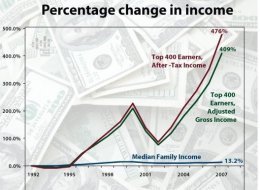
In fact, far from venturing down that road, we’ve been stuck on the road to hyper-capitalism for three decades now. The tea partyers are right to be wary of income redistribution, but if they had even the slightest openness to empiricism, they’d see that the redistribution of the past 30 years has all been upward — radically upward. From 1950 through 1980, the share of all income in America going to the bottom 90 per cent of Americans — effectively, all but the rich — increased from 64 per cent to 65 per cent, according to an analysis of tax data by economists Thomas Piketty and Emmanuel Saez. Because the nation’s economy was growing handsomely, that means that the average income of Americans in the bottom 90 per cent was growing, too — from $17,719 in 1950 to $30,941 in 1980 — a 75 per cent increase in income in constant 2008 dollars.
Since 1980, it’s been a very different story. The economy has continued to grow handsomely, but for the bottom 90 perc ent of Americans, it’s been a time of stagnation and loss. Since 1980, the share of all income in America going to the bottom 90 per cent has declined from 65 per cent to 52 per cent. In actual dollars, the average income of Americans in the bottom 90 percent flat-lined — going from the $30,941 of 1980 to $31,244 in 2008.
In short, the economic life and prospects for Americans since the Reagan Revolution have grown dim, while the lives of the rich — the super-rich in particular — have never been brighter. The share of income accruing to America’s wealthiest one per cent rose from nine per cent in 1974 to a tidy 23.5 per cent in 2007.
Looking at these numbers, it would be reasonable to infer that when the tea partyers say that they want to take the country back, they mean back to the period between 1950 and 1980, when the vast majority of Americans encountered more opportunity and security in their economic lives than they had before or since. Reasonable, but wrong. As the right sees it, America’s woes are traceable to the New Deal order that Franklin Roosevelt, working in the shadow of the even more sinister Woodrow Wilson, imposed on an unsuspecting people.
In fact, the New Deal order produced the only three decades in American history — the’50s,’60s and’70s — when economic security and opportunity were widely shared. It was the only period in the American chronicle when unions were big and powerful enough to ensure that corporate revenue actually trickled down to workers. It marked the only time in American history when, courtesy originally of the GI Bill, the number of Americans going to college surged. It was the only time when taxes on the rich were really significantly higher than taxes on the rest of us. It was the only time that the minimum wage kept pace (almost) with the cost of living. And it was the only time when most Americans felt confident enough about their economic prospects, and those of their nation, to support the taxes that built the postwar American infrastructure.
Since the ascent of Ronald Reagan, though, America’s claim to being a land of opportunity has become a sick joke. Unions have dwindled; colleges have become unaffordable; manufacturing has gone abroad; taxes on the rich have plummeted; and American infrastructure has decayed.
But the country the right wants to return to isn’t the America that the Greatest Generation built. Judging by the statements of many of the Republican and tea party-backed candidates on next Tuesday’s ballots, it’s the America that antedates the New Deal — a land without Social Security, unions or the minimum wage. It’s the land that the Greatest Generation gladly left behind whey they voted for and built the New Deal order.
All of us should want our country back, but that country should be the more prosperous and economically egalitarian nation that flourished at the time when America was not only the world’s greatest power, but also a beacon to the world.
Harold Meyerson is editor-at-large of American Prospect and the L.A. Weekly. (Washington Post)
http://news.guelphmercury.com/Opinions/Editorials/article/710528
http://www.washingtonpost.com/wp-dyn/content/article/2010/10/26/AR2010102605216.html?hpid=opinionsbox1
Saturday, October 16, 2010
Nyles Kendall: Republicans out of touch with working class

Writing in the Arizona Daily Wildcat, Nyles Kendall exposes the anti-working families agenda of the Republican Party:
Republicans have been riding a wave of increasingly favorable public opinion for the past two years, but their anti-working class agenda will lose them votes at the ballot box this November.
In an interview on MSNBC's "The Last Word," host Lawrence O'Donnell asked Republican National Committee Chairman Michael Steele to specify the amount of the federal minimum wage.
After attempting to change the subject and accusing O'Donnell of "trap playing," Steele, unable to answer the question, declared that the minimum wage was irrelevant, a slap in the face to the country's estimated 980,000 minimum-wage workers.
Steele's days as chairman of the RNC are numbered. He will have plenty of time to learn about the relevance of the federal minimum wage while waiting for his weekly unemployment compensation to kick in.
But Steele is not alone in his indifference to the plight of America's minimum wage worker. Several Republican Senatatorial candidates seemingly agree with the chairman's statements.
Rand Paul of Kentucky, Linda McMahon of Connecticut and Washington's Dino Rossi have all entertained the idea of adjustments to the federal minimum wage. John Raese of West Virginia believes it should be abolished altogether. "I profess that (the) minimum wage be eliminated and we operate on the laws of supply and demand just like we did before the depression," the wealthy businessman said at a candidate forum last month.
Alaskan Tea Party candidate Joe Miller has even suggested that the federal minimum wage is unconstitutional. If he had paid attention in high school civics, he would be aware of the fact that its constitutionality was affirmed in 1941, nearly 70 years ago.
In recent months, Republicans have provided an ailing Democratic Party with plenty of political ammo. Democrats have used Steele's recent statements to hammer the theme that Republicans will repeal the minimum wage. This strategy will undoubtedly prove advantageous this November, given that the Republican Party's base is overwhelmingly blue-collar.
Former Republican Speaker of the House Newt Gingrich added insult to injury last week, urging Republican candidates to portray Democrats as the party of food stamps, a program which currently serves 37.9 million Americans.
Such rhetoric alienates the independent voter as well as the nearly 50 million unemployed people struggling to make ends meet in the current economic recession.
According to a survey conducted by the Public Religion Research Institute, nearly two-thirds of Americans favor increasing the minimum wage to at least $10 an hour. 51 percent of the survey's respondents identified themselves as Republican.
The party's unequivocal opposition to the federal minimum wage, like its intent to extend the Bush tax cuts, only lends credence to the argument that Republicans are far too accommodating to the wealthy.
The federal minimum wage was established in 1938, at the height of the Great Depression, in order to ensure a "minimum standard of living necessary for health, efficiency and general wellbeing." Reducing or eliminating the minimum wage in a recessionary economy is not only economically unsound but immoral.
The Republican Party, far too concerned with serving the interests of corporate bankers and multi-millionaires, has once again proven that it is abysmally out of touch with America's working class.
http://wildcat.arizona.edu/perspectives/republicans-out-of-touch-with-working-class-1.1687255
Thursday, October 14, 2010
Lee Fisher is the clear choice for Ohio voters concerned about jobs and the economy

Cuyahoga Falls, OH ~ “I will not only be a vote for fair and balanced trade [in the U.S. Senate],” said Lee Fisher, Ohio’s Democratic Candidate for U.S. Senate, “I will be a tireless advocate for fair and balanced trade.”
The Coalition for a Prosperous America (CPA) held the Ohio Senate Candidate Forum at the Sheraton in Cuyahoga Falls, Ohio this morning. Candidate Lee Fisher (D) attended and answered voter questions. Candidate Rob Portman was invited but declined to attend due to scheduling difficulties. Mr. Portman did send a surrogate to make a statement and take voter questions back to campaign headquarters.
Fisher accused Rob Portman of helping cause the trade deficit, manufacturing decline and job losses when Portman was U.S. Trade Representative in the Bush Administration. “Rob Portman repeatedly chose not to do anything about currency manipulation when he was in a position to take action,” Fisher said.
Fisher also said that he supports HR 2378 which the House of Representatives passed on September 29, 2010 to neutralize foreign government currency manipulation. He favors tax credits for manufacturing in America to offset foreign value added taxes. Fisher further said he supports the TRADE Act which would evaluate past trade agreements for efficacy and plot a course for a new trade policy that would balance trade.
“We appreciate Mr. Fisher’s support for balanced trade,” said Michael Stumo, CEO of CPA. “The Great Recession was caused in large part by ill-conceived trade policy at the federal level. We are dedicated to educating candidates, voters and elected officials so they make smart decisions on future trade policy.”
Other speakers at the event were Jacki Adams (Northeast Ohio Campaign for American Manufacturing); Bruce Cain (Xcel Mold & Machine, Canton, OH); Peter Yoder (Yoder Agriculture); John Wagner (Tri-County AFL-CIO); Joe Logan (farmer and CPA Co-Chair for Agriculture); and Tim Burga (Ohio AFL-CIO).
“Voters need to know where their candidates stand on trade issues to make intelligent decisions on November 2,” continued Stumo. “Ohio has been particularly hard hit with job and manufacturing losses caused by federal trade policy. Only by a single-minded focus on balanced trade can we achieve full employment and sound growth for our manufacturers and farmers.”
Wednesday, October 13, 2010
Levin and Donnelly show leadership on manufacturing and trade issues

House Ways and Means Committee Chairman and Michigan Representative Sandy Levin and Congressman Joe Donnelly of Indiana held a roundtable discussion about trade and manufacturing issues at Mack Tool and Engineering in South Bend. Also in attendance were representatives from Nucor, Reliable Metalcraft, Value Tool and Engineering, and the Alliance for American Manufacturing.
One of the most pressing concerns for Hoosier manufacturers voiced by attendees was the advantage Chinese competitors gain from that country’s unfair manipulation of their currency.
Supported by Donnelly and Levin, H.R. 2378, The Currency Reform for Fair Trade Act, passed the House of Representatives by a broad bipartisan vote on September 29 and seeks to level the playing field for our small businesses by targeting exchange rate misalignment between the U.S. Dollar, Chinese Yuan and other major trading partners in order to reduce the unnatural comparative advantages that command economies like China’s can use against market economies.
“It’s past time to crack down on Chinese currency manipulation. It is estimated that China’s continued undervaluing of its currency has already cost 55,000 Hoosier jobs, with 6,000 of those in north central Indiana alone,” said Donnelly. “I will continue to work in Congress with leaders like Chairman Levin to fight against Chinese currency manipulation and other unfair trade policies that are bad for Hoosier businesses and bad for working families.”
A report by the Alliance for American Manufacturing and the Economic Policy Institute conducted a study examining job loss due to currency manipulation and found that 6,000 jobs have been lost in Indiana’s Second Congressional District. China undervalues its currency by anywhere from 15 to 40 percent, keeping the prices of its exports artificially low, undercutting the market for American-made goods, and forcing American businesses to close.
“U.S. workers and businesses can compete if the playing field with China is level, and I am proud to have worked with Joe Donnelly to get this landmark legislation to safeguard U.S. industries and U.S. jobs from China’s currency manipulation approved by the U.S. House,” said Rep. Sander Levin, Chairman of the Committee on Ways and Means. “Standing up for U.S. jobs and forcing China to play by the rules is vital to Indiana and throughout our nation’s manufacturing base.”
Saturday, September 11, 2010
Jack Conway: A Fighter for Kentucky's Working Families

The choice is clear in the Kenucky U.S. Senate. A fighter for Kentucky's working families like Jack Conway or Rand Paul who wants to ship our jobs overseas, privatize Social Security and legalize drugs.
Jack Conway has a record of getting results for the people of Kentucky. Elected in 2007 as Attorney General, Jack previously served as Deputy Cabinet Secretary and Deputy General Counsel in Governor Paul Patton’s administration from 1996 to 2001. While there he worked to craft economic development programs that put the Commonwealth on a path to prosperity and the landmark 1997 higher education reform bill, which won national acclaim for propelling Kentucky’s institutions of higher learning into the 21st century.
Jack Conway has always considered the highest duty of a public servant to be protecting those who are unable to protect themselves. Since the voters of Kentucky elected Jack as Attorney General, his office has increased Medicaid fraud
prosecutions by 600%, saving over $100 million for Kentucky taxpayers. He has advocated for consumers and saved Kentucky families over $100 million from proposed utility rate increases. Jack has sued the big oil companies for gas price gouging, and in his first year as Attorney General, increased elder abuse and neglect investigations by 300%. He followed through on his commitment to prosecute child predators and crack down on Internet crimes when he created a Cybercrimes Unit, which has initiated numerous child pornography investigations, eliminated over 68,000 illegal images and videos from the Internet, and continues to conduct trainings for police and prosecutors across Kentucky.
Simultaneously, Jack reduced costs in the Attorney General’s office by 26%, setting a strong example by taking a pay cut and giving his official vehicle back to the state. Jack has a proven record of combating waste, fraud, and abuse in government.
As a United States Senator, Jack has a plan to create jobs, cut the deficit, and restore accountability to Wall Street and Washington. Jack has a plan, which is estimated to create 731,000 jobs nationwide and 10,975 jobs in Kentucky through a
combination of tax credits and small business lending. He has already identified $430 billion in savings that can be recouped for taxpayers by: shutting down offshore tax shelters and closing loopholes in the corporate tax code that encourage companies to invest and ship jobs overseas; making big pharmaceutical companies negotiate with Medicare for lower prices on prescription drugs; and eliminating waste, fraud, and abuse in Medicare. Additionally, Jack will fight for Wall Street reform that puts taxpayers first, protects consumers, and cracks down on the big banks by preventing any institution from ever again becoming “too big to fail.”
Jack is a proud Kentuckian. His father, Tom, was born on a family farm in Western Kentucky’s Union County. He put himself through law school at night at the University of Louisville, while teaching history and coaching at Fairdale High
School. Jack’s mother, Barbara grew in up in Louisville’s South End, the daughter of a union blacksmith.
Jack Conway holds an undergraduate degree in public policy from Duke University and a law degree from The George Washington University. Conway is married with one daughter.
In contrast to Jack Conway's advocacy for working families, Rand Paul is a proven enemy of Kentucky workers.
From the AFL-CIO NOW Blog:
Kentucky State AFL-CIO President Bill Londrigan doesn’t pull punches when he talks about the Bluegrass State’s Tea Party-backed Republican U.S. Senate candidate. Speaking to a sun-baked crowd at Paducah’s 35th annual Labor Day picnic Monday, he warned:
A vote for Rand Paul is a vote for the continuation of the economic nightmare now facing workers across Kentucky. Vote like your job depends on it—because it does.
The state AFL-CIO unanimously endorsed Democrat Jack Conway over Paul, whose anti-union views earned him a $2,500 donation from the National Right to Work Committee.
Conway is the state’s attorney general. An ophthalmologist, Paul is the son of Rep. Ron Paul (R-Texas). Dr. Paul is bad medicine for Kentucky’s working families, according to Londrigan.
He supports privatizing Social Security and increasing the retirement age for Social Security eligibility. He supports so-called free trade agreements like NAFTA, which are responsible for shipping millions of good-paying American jobs overseas.
When it comes to jobs safety, a vital issue for state’s coal miners and other workers, Londrigan said Paul’s response to catastrophic mine accidents and oil rig explosions is:
“‘accidents happen.” In Rand Paul’s world, corporations should be completely unregulated so they can cook the books and undermine our economy.
Londrigan went on to highlight the differences between Rand Paul’s world and the world in which most Kentucky workers live.
In Rand Paul’s world, Social Security is a burden and not a reward for a lifetime of hard work and sacrifice and something to be handed over to Wall Street.
In Rand Paul’s world, the budget deficit is a monstrous problem, but tax cuts for the rich are still a priority.
In Rand Paul’s world, teachers and the Department of Education are a hindrance to learning. In Rand Paul’s world, farm subsidies are a handout. In Rand Paul’s world, lowering workers’ wages is the way out of a recession.
And in Rand Paul’s world, property rights trump civil rights. If you’re an ordinary American, a hard-working Kentuckian, you can’t afford to live in Rand Paul’s world.
Jeff Wiggins, a United Steelworkers (USW) members and president of the Paducah-based Western Kentucky Area Council, said Kentucky union families are a vital element in the fight to send Conway to the Senate and Paul back to his practice.
But Wiggins, the Labor 2010 coordinator for western Kentucky, also says working families must be mobilized. He doubts Paul will win many union votes, but says the Republican is hoping for the next best thing: a slew of union card-carrying Kentuckians will forget that the GOP’s gospel of greed caused the recession, will blame hangover hard times on the Democrats and will show their disdain by not voting.
Wiggins has a message for potential non-voting union members:
If you stay home on Nov. 2, you’ll be helping the same sort of people who tried to push labor off the cliff under Bush. Democrats like Jack Conway want to throw us a rope and pull us away from the edge. But Republicans like McConnell and Paul still want to push us off.
http://blog.aflcio.org/2010/09/10/workers-dont-fit-into-rand-pauls-world/
Saturday, September 04, 2010
Study Finds No Economic Benefit from "Right-to-Work" laws

Michael Wasser, a research intern at American Rights at Work, dismantles the arguments for right-to-work (for less) laws:
Proponents of so-called “right-to-work laws,” such as the U.S. Chamber of Commerce and the National Right to Work Committee, argue that they create a more business-friendly environment and lead to economic growth for states and their residents.
But is that really the case?
As Jack Hough noted in a recent Smart Money article, new research suggests that the supposed economic benefits of right-to-work laws may be little more than useful rhetoric for the law’s supporters. http://www.smartmoney.com/personal-finance/employment/do-labor-unions-hurt-employment/#
Because of a provision added to the National Labor Relations Act in 1947 through the Taft-Hartley amendments, states may pass right-to-work laws. These laws ban agreements stipulating that all employees represented by a union have to pay dues. Right-to-work laws currently are on the books in 22 states.
The new research on the economic effects of these laws comes from Lonnie Stevans, Professor of Information Technology and Quantitative Methods at Hofstra University. He compared the business formation and economic growth of right-to-work states with non-right-to-work states using recent data from the U.S. Small Business Administration. Stevans controlled for variables like education levels, population changes, and type of employment in the states to accurately measure the relationship between right-to-work laws and economic growth. http://www.bepress.com/rle/vol5/iss1/art25/
As the Smart Money article states:
Stevans found that RTW [right-to-work] states had lower per-capita income for workers, but higher income for business owners, than non-RTW states… According to Stevans, there’s little evidence of a ‘trickle down’ of benefits in RTW states from business owners to workers.
He also didn’t find evidence that right-to-work legislation affects the states’ employment rates.
Professor Stevans’s findings cast a pall of doubt over the economic claims of right-to-work supporters. Though their talking points may remain unchanged, the fact is right-to-work laws do not improve the economic viability of states and their workers. And as John Adams once said, “Facts are stubborn things…”
http://americanrightsatwork.org
Labor Day 2010: America's Workers Losing Ground

The well-respected Economic Policy Institute provides some alarming statistics for us this Labor Day. There is no doubt at it. Our middle and working class in the USA faces a bleak future thanks to many years of deregulation, union-busting, so-called free trade agreements, outsourcing and tax breaks for the rich. It is time for American workers to fight back and demand an end to tax policies which allow corporations to profit for shipping our jobs overseas. The Employee Free Choice Act has to become law. We need to repeal the Bush tax cuts for the rich. President Obama must impose a 10% tariff on imports to reduce the massive trade deficit which is destroying U.S. jobs. We must hold our Democratic President and Congress accountable but the solution is definitely not to elect more reactionary Republicans with absolutely nothing to offer America's middle class.
Labor Day by the Numbers
Anna Turner
September 3, 2010
(Note that all numbers are current as of September 3, 2010. States numbers are current as of August 20, 2010.)
JOBS NEEDED TO REGAIN PRE-RECESSION EMPLOYMENT RATE: 11 MILLION
Change in total jobs in August 2010: -54,000; Change in jobs in August 2010, excluding 114,000 temporary U.S. Census Bureau jobs lost that month: +60,000
Change in private-sector jobs in August 2010: +67,000
Change in public-sector jobs in August 2010: -121,000; Change in public sector jobs, excluding 114,000 temporary U.S. Census Bureau jobs lost that month: -7,000
Change in size of the labor force in August 2010: +550,000
Accounting for population growth, number of workers that should have been added to the labor force since December 2007: +3.7 million; Actual change in the size of the labor force since December 2007: +241,000
The number of unemployed workers for every job opening: 5
Total jobs lost since the start of the recession: -7.6 million
Manufacturing jobs lost since the start of the recession: -2.0 million (14.9% of sector’s jobs)**
Construction jobs lost in the recession: -1.9 million (25.1%, one in four construction jobs)**
UNEMPLOYMENT RATE: 9.6%
Number unemployed: 14.9 million (up from 7.7 million in December 2007)**
Portion of unemployed who have been jobless more than six months: 42%
Portion of unemployed who have been jobless more than a year: 21.9%**
Underemployment rate: 16.7%; Number of under- and unemployed, marginally attached, and involuntary part-time workers: 26.1 million
Male unemployment: 10.6%; female unemployment: 8.6%
White unemployment: 8.7%; black unemployment: 16.3%; Hispanic unemployment: 12.0%
Average weekly unemployment benefit in July: $306; Average weekly benefit in July for those who still receive the $25 provided by the American Recovery and Reinvestment Act: $331;
STATES WITH DOUBLE-DIGIT UNEMPLOYMENT IN JULY 2010: 11
Highest unemployment rate: Nevada, 14.3%; lowest: North Dakota, 3.6%
Highest black unemployment rate: Michigan with 23.7%; Highest Hispanic unemployment rate: Nevada with 18.4%
Total change in number of state and local government jobs over the last two years (since the peak in August 2008): -282,000 jobs
CHANGE IN PRODUCTIVITY 2002-07: +11%; CHANGE IN MEDIAN COMPENSATION 2002-07: -0.6%**
Annual private-sector nominal hourly wage growth in the year before the recession: 3.4%; Nominal wage growth in 2010/2009: 1.6%
Share of income growth going to the top 1% of households from 1989 to 2007: 56%; Share of income growth going to the bottom 90% of households: 16%
Ratio of average CEO’s pay to typical worker’s pay in 1973: 27 to 1; Ratio right before the recession in 2007: 275 to 1
OVERALL SOCIAL SECURITY BENEFIT CUT FROM CURRENT RETIREMENT AGE INCREASE (65 to 67): 13%
Average annual Social Security benefit for a retiree: $14,050
Share of retirees receiving all their income from Social Security: more than 1 out of 4
Share of retirees receiving more than half of their income from Social Security: 69%
Share of older Americans (age 45 onwards) who prematurely took out funds from their 401(k), IRA, or other retirement investments in 2009: 18%; Share of Hispanic older Americans who did so: 22%; Share of African American older Americans who did so: 26%
Total decline in assets from pensions, 401(k)-style accounts and IRAs between 2007 and 2009: $1.5 trillion
Number of workers whose employers do not offer a retirement plan: 78 million (49%)
UNEMPLOYMENT RATE FOR YOUTH (16-24): 18.1%
Share of youth (16-24) who are neither employed nor enrolled in school:* 17.9%
Number of young people (16-24) who have dropped out of the labor force since the recession began:* 1.1 million
Youth (16-24) share of the labor force in August 2010:* 13.6%; Youth share of the unemployed:* 25.6%
Unemployment rate for young (16-24) black workers in January 2010: 32.5%; For young Hispanic workers: 24.3%; For young white workers: 15.2%
The average student debt of graduates from private four-year institutions in 2000/01: $16,906; Average debt in 2007/08: $25,350
ANNUALIZED RATE OF GDP GROWTH, 2nd QUARTER, 2010: 1.6%
When the American Recovery and Reinvestment Act will cease to provide any boost to growth rate of GDP: Last quarter of 2010
Change in size of the economy since the start of the recession 31 months ago:* shrunk 1.3%
Number of full-time equivalent jobs supported through expansion of unemployment insurance since the beginning of the recession: 1.7 million
* Data is newly updated by EPI but links to original reports with older numbers.
** EPI calculation using Bureau of Labor Statistics
http://www.epi.org/publications/entry/labor_day_by_the_numbers1
Subscribe to:
Posts (Atom)